


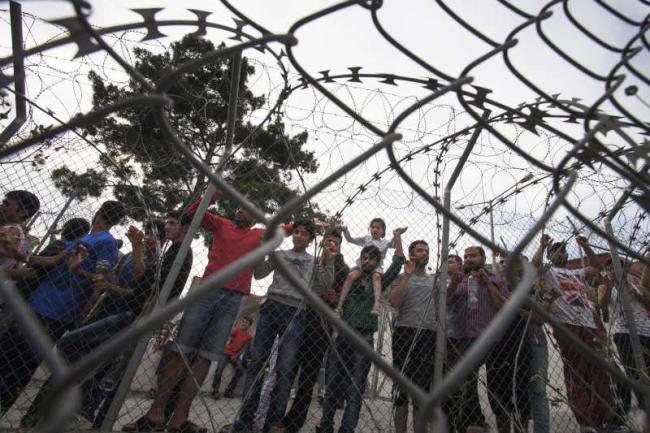
UN refugee agency commends Greece on asylum reforms, urges more to be done
According to a recent UNHCR report, Greece has seen, over the past year, “a dramatic increase” in refugee and migrant arrivals by sea, with some 43,500 people making the perilous journey across the Mediterranean – a 280 per cent increase from 2013.
Most of the refugees, around 60 per cent, were from Syria, but there were also substantial numbers of Afghans, Somalis and Eritreans, the UN agency noted.
Europe, facing conflicts to its south in Libya, east in Ukraine, and southeast in Syria and Iraq, is currently seeing the largest number of sea arrivals with 207,000 people crossing the Mediterranean to reach its shores – almost three times the previous known high of about 70,000, registered in 2011.
Against this backdrop, the reforms to Greece’s asylum process have not eradicated all of the system’s problems as refugees and migrants continue to encounter difficulties in accessing the asylum procedure and face the risk of arbitrary detention, inadequate reception conditions, lack of identification and support for individuals with specific needs and push-backs of people at the border.
“We continue to document accounts of informal returns at the Greek-Turkish land and sea borders,” UNHCR spokesperson William Spindler said on Thursdayat a press conference in Geneva, as he presented the report’s findings.
Greek authorities, on the other hand, also continue to struggle with a backlog of some 37,000 appeals generated under the old system which have prevented them from considering and processing new applications. At the same time, accommodation for asylum-seekers remains scarce and insufficient and integration prospects and related support for refugees are practically non-existent.
In addition, although many of Greece’s migrants ultimately move on to other European States, UNHCR has also urged other nations within the European Union to refrain from returning those migrants to Greece, reiterating advice previously issued in 2008.
“UNHCR is ready to continue working with the Greek authorities to address these challenges and encourages EU member states and institutions to continue to extend their support to Greece,” Spindler concluded.
Photo: UNHCR/A. D’Amato
Support Our Journalism
We cannot do without you.. your contribution supports unbiased journalism
IBNS is not driven by any ism- not wokeism, not racism, not skewed secularism, not hyper right-wing or left liberal ideals, nor by any hardline religious beliefs or hyper nationalism. We want to serve you good old objective news, as they are. We do not judge or preach. We let people decide for themselves. We only try to present factual and well-sourced news.
Support objective journalism for a small contribution.


