


 UN
UN
UN’s rights council adopts ‘fake news’ resolution, States urged to take tackle hate speech
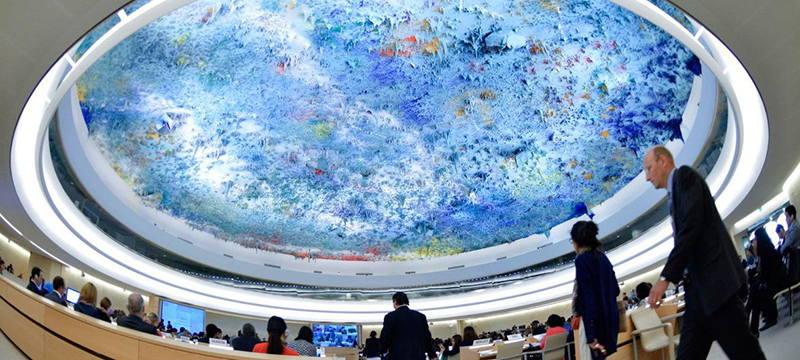
At the UN Human Rights Council on Friday, Member States adopted a plan of action to tackle disinformation, at the request of Ukraine and with widespread – but not universal - support.
Officially sponsored by Ukraine, Japan, Latvia, Lithuania, Poland, the UK and US, the draft resolution presented to the Geneva forum emphasised the primary role that governments have, in countering false narratives.
It notes with concern, “the increasing and far-reaching negative impact on the enjoyment and realization of human rights of the deliberate creation and dissemination of false or manipulated information intended to deceive and mislead audiences, either to cause harm or for personal, political or financial gain”.
‘Common enemy’
Although China said that disinformation was a common enemy of the international community, it disassociated itself from adopting the draft resolution, saying that there was too little emphasis on the root causes of fake news, and the role of human rights mechanisms.
Venezuela also declined to approve the text, citing bias and alleging that some of the sponsors of the draft resolution were behind disinformation campaigns.
France, meanwhile, insisted that disinformation was increasingly being used to attack human rights activists and journalists and urged more coordination and efforts among States to tackle it.
Echoing that message, India, noted that that social media companies had an important role to play in combating fake news, as its impact on our societies was increasing.
For its part, Indonesia said that countering disinformation was a top priority, before insisting that policies were best designed by national authorities, to take into account cultural differences.
Digital boom
Although disinformation is not new, modern-day digital tools and social media platforms have allowed maliciously incorrect information to spread widely, before false facts can be challenged and removed.
At a global level, the dissemination of fake news came to the fore in the early months of the COVID-19 pandemic, with unscientific remedies and anti-vaxxers gaining a massive online following among communities who were taken in by a proliferation of fake news and rumours.
In Colombia, the UN office there highlighted how several Latin America countries were targeted by enticing WhatsApp messages that said: “Stay home, the UN will bring you food,” in exchange for sharing personal data.
“It was false, of course. Yet, it led some people to go to the UN office, hoping to be given something to eat,” said Hélène Papper, head of UNIC Colombia.
Eroding trust in Ukraine
The problem has also surfaced in the Ukrainian crisis and affected the International Committee of the Red Cross (ICRC), which has said that its lifesaving work there has been undermined by a “deliberate and targeted campaign of misinformation” aimed at destroying the relationship of trust that humanitarians need, to operate independently in war zones.
“False narratives around humanitarian work are dangerous,” ICRC spokesperson Ewan Watson told journalists in Geneva on Friday, adding that although the misinformation campaign was ongoing, “I’m relieved that it hasn’t translated into an inability to work”.
The Council’s decisions are not legally binding but carry the weight of the world’s pre-eminent body dedicated to promoting and protecting human rights.
Support Our Journalism
We cannot do without you.. your contribution supports unbiased journalism
IBNS is not driven by any ism- not wokeism, not racism, not skewed secularism, not hyper right-wing or left liberal ideals, nor by any hardline religious beliefs or hyper nationalism. We want to serve you good old objective news, as they are. We do not judge or preach. We let people decide for themselves. We only try to present factual and well-sourced news.
Support objective journalism for a small contribution.


