


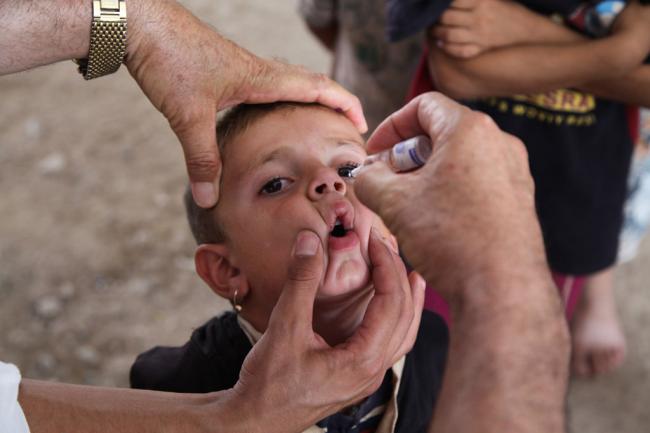
WHO notes threat of polio spread in conflict-affected countries
“Furthermore, countries affected by conflict inevitably experience a decline in health service delivery that leads to deterioration of immunization systems in a number of such at-risk countries,” said the statement on a meeting of the agency’s Emergency Committeeregarding the international spread of wild poliovirus, dated 27 February and released by WHO on Wednesday.
The meeting “noted that the international spread of wild poliovirus has continued with one new exportation from Pakistan into neighbouring Afghanistan documented after 13 November 2014.”
“Although there is seasonal decline in the number of reported cases in Pakistan, transmission is ongoing in each of the four provinces and the Federally Administered Tribal Areas,” the statement said, but “assessed the risk of international spread from Pakistan to be sustained.”
Referring to Cameroon, Equatorial Guinea, Syria, Pakistan, Afghanistan, Nigeria, Somalia, Ethiopia, Iraq, and Israel, the statement said, Although the risk of new international spread from the nine other infected Member States appears to have declined, the possibility of international spread still remains a global threat worsened by the expansion of conflict-affected areas, particularly in the Middle East and Central Africa.”
The Committee assessed that the spread of polio still constitutes a Public Health Emergency of International Concern, and made a series of recommendations to prevent further spread and to eradicate the highly infectious viral disease, which mainly affects young children.
According to WHO, the virus is transmitted by person-to-person spread mainly through the faecal-oral route or, less frequently, by a common vehicle (e.g. contaminated water or food) and multiplies in the intestine, from where it can invade the nervous system and can cause paralysis.
Initial symptoms of polio include fever, fatigue, headache, vomiting, stiffness in the neck, and pain in the limbs. In a small proportion of cases, the disease causes paralysis, which is often permanent. There is no cure for polio, it can only be prevented by immunization.
Photo: UNICEF/ Wathiq Khuzaie
Support Our Journalism
We cannot do without you.. your contribution supports unbiased journalism
IBNS is not driven by any ism- not wokeism, not racism, not skewed secularism, not hyper right-wing or left liberal ideals, nor by any hardline religious beliefs or hyper nationalism. We want to serve you good old objective news, as they are. We do not judge or preach. We let people decide for themselves. We only try to present factual and well-sourced news.
Support objective journalism for a small contribution.


