 Punjab
Punjab needs to junk free power, mono-culture farming to overcome economic woes: NCAER Paper
New Delhi/IBNS: Punjab, which was the beacon of Green Revolution and has been the ‘food bowl’ of India, needs to shed its mono-culture farming, scrap subsidies like free power and water and reorient its industries and services to overcome slow economic growth, high debt, societal challenges like the drug menace and environmental degradation.
The state’s over reliance on the Centre’s food procurement policy makes it heavily agricultural and, that too, in a narrow manner. It needs to diversify its cropping pattern beyond wheat and rice as a first step, argues a paper presented at the India Policy Forum 2024, organized by the National Council of Applied Economic Research (NCAER) here.
The authors- Prof Lakhwinder Singh (Institute of Human Development), Prof Nirvikar Singh (University of California), and Prof Prakarsh Singh (Plaksha University)—attribute the state’s high debt and strained public finances to lack of agricultural diversification and agro-processing industries besides high power and water subsidies.
They find a “disconnect between the current situation and the state’s vision for the medium and long terms”.
“Lack of desirable employment and social problems such as drug and alcohol abuse all seem to stem from Punjab’s lock-in to the agricultural system created by the Green Revolution and an outdated national food procurement policy,” says the NCAER paper, titled “Economic Development of Punjab: Prospects and Policies”.
The authors say that “agriculture based on unprocessed food grains provides little opportunity for tax revenue” and the problem is compounded by huge power and water subsidies. Making a strong case against free power, they point to excessive depletion of groundwater which raises the spectre of desertification.
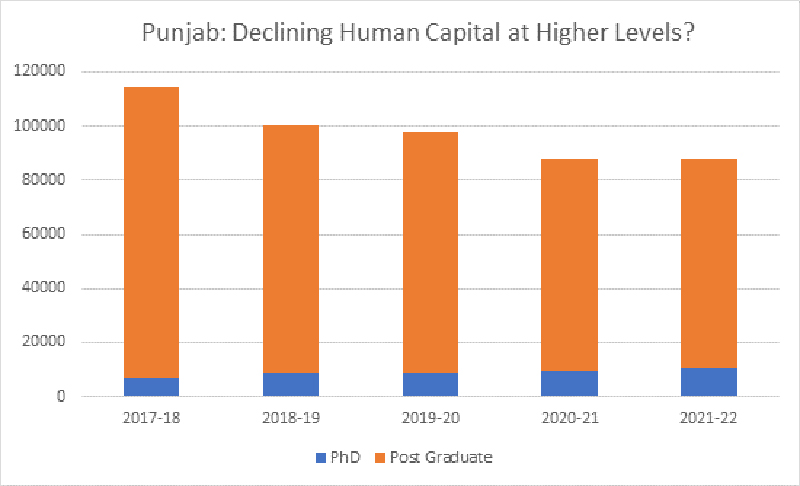 All India Survey on Higher Education 2021-22.
Arguing for support from the Centre for the state to make a farming switch, the NCAER paper says the procurement policy offering unlimited purchase of maize and pulses at MSP if farmers switch from paddy or wheat may not be enough for Punjab and “additional payments may be required, which could be justified politically as compensation for past contributions to national food security”.
The authors say economic liberalization exacerbated the constraints of Punjab’s ‘Green Revolution-food procurement’ economy. The state’s economic structure appears out of date and marked by low productivity and wages. “All this has made Punjab less innovative and less attractive for new investments,” they say.
So how can Punjab come out of the double trap of slow growth and increasing debt? The authors spell out some imperatives like identification of sources of tax evasion and reorienting expenditure for faster transition to a knowledge-based economy.
Regarding the state’s growing problem of unemployment, they say neither rural nor urban jobs are being created that fit individual and societal expectations. Female (15-29) unemployment rate is high at 30% (33% in rural areas). In many parts of India, middle class women’s entry in the labour force is into white collar-type jobs, which is not adequately available in Punjab.
The paper also cites decline in higher education in the state as “expected returns after a PG degree is not realized in the absence of high-skilled jobs”. Besides mechanized agriculture, it attributes high rural unemployment to the state’s peculiar migration constraints. “Surplus rural labour in UP can more easily migrate to Punjab, whereas surplus rural labour in Punjab has to migrate abroad, or shift to skilled jobs in the urban sector, each of which presents greater obstacles,” it says.
Support Our Journalism
We cannot do without you.. your contribution supports unbiased journalism
IBNS is not driven by any ism- not wokeism, not racism, not skewed secularism, not hyper right-wing or left liberal ideals, nor by any hardline religious beliefs or hyper nationalism. We want to serve you good old objective news, as they are. We do not judge or preach. We let people decide for themselves. We only try to present factual and well-sourced news.