Dept of Public Enterprises
Dept of Public Enterprises back with Finance Ministry for better coordination and asset management
New Delhi/IBNS: The Department of Public Enterprises (DPE) which was created in 1965 as Bureau of Public Enterprises (BPE) has been placed under the ministry of finance to allow "direct and better" coordination, according to a media report.
Initially known as BPE, it was under the Union ministry of finance as a centralised coordinating unit appraising performance of public enterprises, said a Hindustan Time report.
It was moved to the ministry of industry in 1985 and five years later it was made a department when it was also shifted to ministry of heavy industries & public enterprises.
The government on Wednesday placed back DPE under the Finance Ministry "to improve efficiency of CPSEs [central public sector enterprises], effective monetisation of their resources that are lying idle and nudge them to promote ‘Aatmnirbhar Bharat’ [Self-reliant India] by procuring goods and services from within the country, particularly from MSMEs [micro, small and medium enterprises],” the Hindustan Times report quoted an official with the knowledge of the matter who did not want to be named.
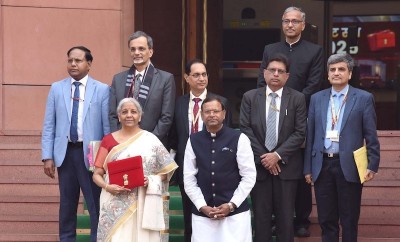
The report citing another official said the move is in line with the finance minister's budget speech on February 1 when she had put special emphasis on asset monetisation.
“A ‘National Monetisation Pipeline’ of potential brownfield infrastructure assets will be launched,” Finance Minister Nirmala Sitharaman had said in her budget speech.
The second official cited above said, “CPSEs have idle or underutilised assets. For example, 156 of them have over 4,000 acres of prime land in various parts of the country, which could be made productive assets. Besides, the change will also facilitate government’s disinvestment programme."
The change in ministerial control of DPE was affected by a notification issued by the Cabinet Secretariat on July 6 which said that the changes will come into effect at once.
After this, the finance ministry will have six departments-- the department of economic affairs (DEA), the department of revenue (DoR), the department of expenditure (DoE), the department of financial services (DFS), the department of investment and public asset management (Dipam), and the DPE.
The ministry of heavy industries and public enterprises is now renamed as the ministry of heavy industries (MHI).
According to the notification, DPE will coordinate matters of general policy affecting all public sector enterprises (PSEs), evaluate and monitor their performances, and review their capital expenditure plans. It will also undertake the “residual work relating to erstwhile Bureau of Public Enterprises [BPE] including Industrial Management Pool [of talented managers],” the notification said.
Other functions of DPE include counselling, training and rehabilitation of employees in CPSEs under voluntary retirement scheme, rendering advice relating to revival, restructuring or closure of a state-run firm and conferring them ‘Ratna’ status.
Support Our Journalism
We cannot do without you.. your contribution supports unbiased journalism
IBNS is not driven by any ism- not wokeism, not racism, not skewed secularism, not hyper right-wing or left liberal ideals, nor by any hardline religious beliefs or hyper nationalism. We want to serve you good old objective news, as they are. We do not judge or preach. We let people decide for themselves. We only try to present factual and well-sourced news.
Support objective journalism for a small contribution.