South Asia remains fastest-growing region; India continues as growth engine: World Bank
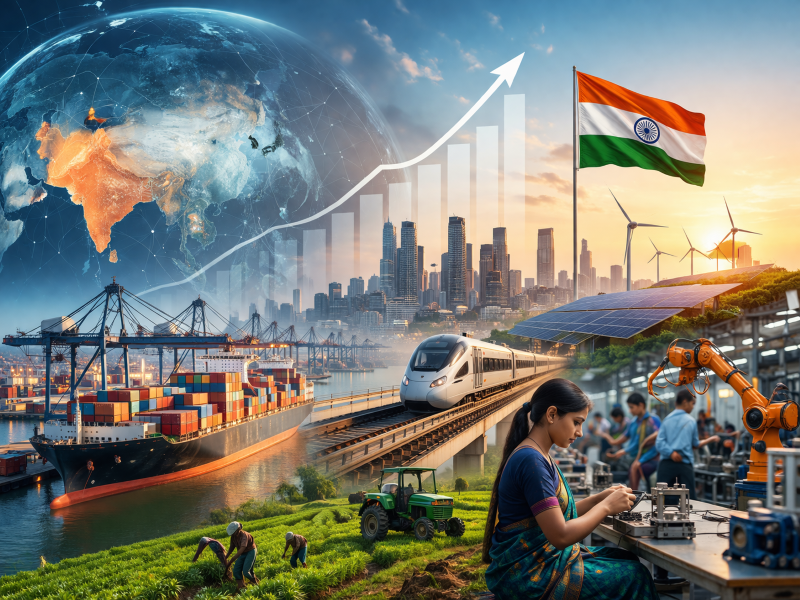
Despite headwinds from global energy market disruptions triggered by the Iran war, South Asia continues to be the world’s fastest-growing region, with India acting as the principal engine of growth, according to the latest report by the World Bank.
At a brainstorming session organised by the National Council of Applied Economic Research in collaboration with the World Bank, experts explored strategies to unlock the region’s full economic potential.
The discussion centred on the South Asia Economic Update (April 2026) and its implications for India. The session was chaired by Suman Bery, Vice Chairman of NITI Aayog.
Key presentations were delivered by Franziska Ohnsorge, Chief Economist for South Asia, and Aurelien Kruse, Lead Economist for India. The discussion also featured insights from Sudipto Mundle and Nagesh Kumar.
Focus on industrial policy and trade reforms
The April 2026 edition of the report provides an in-depth analysis of the role of industrial policy in development.
It examines key features of South Asia’s industrial strategies, their impact on trade, and how the region can maximise gains from such policies. It also explores recent trade reforms and the reshaping of global value chains driven by artificial intelligence.
In his opening remarks, Bery highlighted India’s steady economic rise: “India’s emergence as a major economy at market prices reflects its resilience and the absence of major financial crises. The World Bank’s report serves as an important empirical document for the region.”
He also urged India’s states and Union Territories to consolidate economic gains, avoid labour market fragmentation, and leverage trade to enhance productivity and efficiency.
Strong growth outlook, but job creation a key challenge
Dr Ohnsorge noted: “South Asia is the fastest-growing region globally, primarily driven by India. While growth has moderated due to the ongoing energy crisis stemming from the Middle East conflict, the medium-term outlook remains encouraging.”
She added that long-term growth prospects remain strong, supported by trade reforms and their broader economic impact. However, she emphasised a major structural challenge:
“Over the next 10–15 years, nearly 280 million young people will enter the workforce, making job creation a critical priority.”
India’s growth paradox
Dr Mundle highlighted a key concern in India’s economic trajectory, saying: “India’s growth paradox lies in achieving consistent GDP growth of around 6% while facing persistently high unemployment.
This creates a policy dilemma—whether to prioritise GDP growth or employment generation.”
Dr Kumar stressed that while the region’s growth remains robust despite geopolitical tensions, it must be supported by forward-looking industrial policies aligned with global manufacturing trends.
Key risks and opportunities
The report identifies several challenges facing the region, including:
- Rising geopolitical risks affecting energy prices
- Persistent inflationary pressures
- Weak external demand
- Limited fiscal space
At the same time, South Asia continues to rely heavily on domestic demand.
Looking ahead, trade reforms across the region could unlock additional growth by reducing barriers, especially in emerging export sectors.
However, accelerating job creation is becoming increasingly difficult as employment opportunities weaken in sectors exposed to AI-driven disruption.
Support Our Journalism
We cannot do without you.. your contribution supports unbiased journalism
IBNS is not driven by any ism- not wokeism, not racism, not skewed secularism, not hyper right-wing or left liberal ideals, nor by any hardline religious beliefs or hyper nationalism. We want to serve you good old objective news, as they are. We do not judge or preach. We let people decide for themselves. We only try to present factual and well-sourced news.
Support objective journalism for a small contribution.