


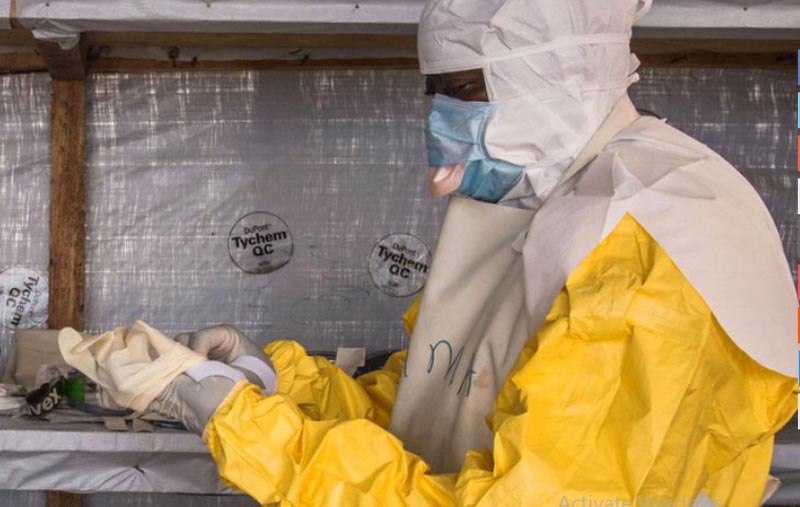
 Guinea Ebola
1,600 vaccinated in Guinea Ebola virus outbreak but more jabs needed: WHO
New York: More than 1,600 people have received Ebola virus vaccinations in Guinea where four have died in a new outbreak, but more lifesaving jabs will be needed to contain the disease, the World Health Organization (WHO) said on Friday.
To date, 18 Ebola cases have been reported in the West African nation (14 confirmed and four deaths); only 30,000 Ebola vaccines are available, out of a global stock of half a million.
“We are using the ring vaccination,” said Dr Ibrahima Socé Fall, the Assistant Director-General of WHO responsible for emergency response, referring to the strategy that inhibits the spread of a disease by vaccinating only those most likely to be infected.
“We are vaccinating the contacts of cases, the contact of contacts, and their contacts. With this strategy we are able to control this type of outbreak. But we are going to need more vaccines,” Dr Fall told journalists in Geneva on Friday.
Limited stocks
“If the outbreak spreads to other countries, we have limited stocks” said the Director of Strategic Health Operations at WHO, Dr. Michel Yao.
He was speaking by videoconference from the town of Nzérékoré in Guinea, one of the epicentres of the outbreak, which is near the border with Liberia and Côte d'Ivoire.
The last Ebola outbreak in Guinea, which started in 2014, quickly spread to neighbouring Liberia and Sierra Leone. By the time it was finally brought under control, it had become the deadliest Ebola outbreak since the virus was first detected in 1976, with some 28,000 cases and 11,000 deaths.
Borderline readiness
“There are six neighbouring countries to Guinea, and we conducted a self-assessment of readiness,” said Gueye Abdou Salam, Regional Emergency Director of WHO’s regional office for Africa, speaking from Brazzaville. “Two of the countries are not ready, and one country is on the borderline and there are three countries that are more or less ready.”
Having faced previous Ebola outbreaks has given health authorities a considerable advantage this time around, the experts agreed.
“It is important to learn the lessons from these outbreaks,” said Dr. Georges Alfred Ki-Zerbo, the WHO Representative in Guinea, who highlighted the need to secure the trust of local communities in all the areas where vaccination campaigns were planned.
“Where we launch the vaccination campaign in Gouecke, a few kilometres from there is the village of Wome. This is where a team of officials and responders were trapped and actually killed in the last outbreak in 2015. So, we need to take that into account when we engage with communities to make sure that we listen to them,” Dr. Ki-Zerbo said.
Deadly pathogens
There is broad consensus among health officials that acting quickly is a crucial factor in controlling the spread of Ebola, but that preventive measures and better preparedness are also needed to protect people from a broader range of pathogens.
Dr Fall maintained that the world will face an increasing number of health epidemics, especially as human habitats encroach on forest areas.
“We are increasingly in a situation in which we have to face multiple epidemics,” he said. “Countries must be enabled to respond to multiple epidemics, but especially through preventive measures.”
One current challenge is that the strong focus on the COVID-19 pandemic is making it more difficult to focus global attention on the tools needed to respond to any other emerging pathogens.
Support Our Journalism
We cannot do without you.. your contribution supports unbiased journalism
IBNS is not driven by any ism- not wokeism, not racism, not skewed secularism, not hyper right-wing or left liberal ideals, nor by any hardline religious beliefs or hyper nationalism. We want to serve you good old objective news, as they are. We do not judge or preach. We let people decide for themselves. We only try to present factual and well-sourced news.
Support objective journalism for a small contribution.


