


All missions on board for NASA Heliophysics research
Washington, Nov 28 (IBNS): Scientists have been studying the near-Earth environment for the better part of a century, but many mysteries — like where the energetic particles that pervade the area originate and become energized — still remain.
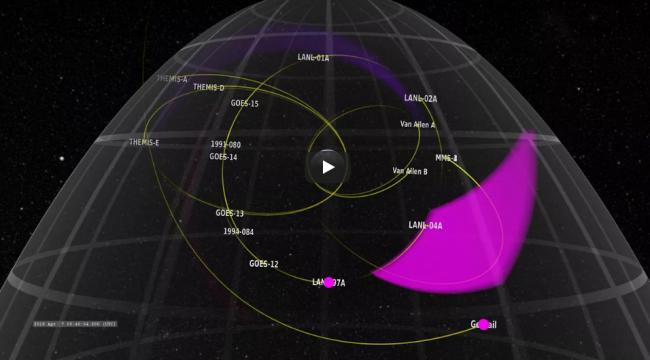
In a new type of collaborative study, scientists combined data from 16 separate NASA and Los Alamos National Laboratory (LANL) spacecraft to understand how a particle phenomenon in the magnetic environment around Earth occurs, read the NASA website.
These events, called substorms, can cause auroras, disrupt GPS communications and, at their most intense, damage power grids.
To get a global picture, the scientists used data from four individual NASA missions — the Magnetospheric Multiscale mission, Van Allen Probes mission, Geotail, and the Time History of Events and Macroscale Interactions during Substorms mission — plus the LANL-GEO spacecraft. This research showcases how NASA heliophysics missions — heliophysics being the study of the nature of charged particles and energy in space, as well as how they are affected by the Sun — can work together.
The scientists chose an event during a quiet period in the near-Earth space environment, which they assumed would provide a simple case that would be easy to model. What they found proved otherwise.
“Even for this small event, it’s tremendously complex,” said Drew Turner, research scientist at The Aerospace Corporation in El Segundo, California. “What this shows is we don’t yet have a good global picture for what’s happening during small substorms, let alone during the big whoppers.”
Data from each individual mission is only able to provide a snapshot of what the environment looks like at a specific place and a specific time. While this allows scientists to understand some space plasma phenomena in detail, it is difficult to get a comprehensive picture of where the particles came from and where they’re going. However, by combining datasets from spacecraft situated in locations spread around Earth, Turner and his team were able to address big-picture questions about particle movement.
“Each spacecraft plays a unique role,” Turner said. “As we move forward and continue shaping the future of magnetospheric physics, the global picture of substorms and other important phenomena will become clearer as more spacecraft are deployed using innovative orbital configurations and instrumentation.”
In addition to getting a view of how complicated the system can be, the results also helped the researchers learn about substorm structure.
“We often consider substorms to be the ‘building blocks’ of the solar wind and magnetosphere interaction — the fundamental element,” said David Sibeck, THEMIS project scientist and Van Allen Probes mission scientist at NASA’s Goddard Space Flight Center in Greenbelt, Maryland. “That’s one reason why we study them.”
The researchers, using ground-based magnetometers, found a signature of what’s known as a substorm current wedge — one of the major features of a classic substorm. This result, combined with the spacecraft data, showed there is activity around Earth for more than an hour leading up to wedge formation, a process that has been hotly debated in the past. Their results have been published in the Journal of Geophysical Research.
Turner and his team are already looking at more events to see if what they’ve found in the first event is typical of substorms. Now that one of the missions — the Magneotspheric Multiscale mission — is in a new orbit that takes it father from Earth, the team expects to be able to see the point of origin of the events and hopefully capture a complete start-to-finish picture of a substom event.
The four NASA missions used in this study are a part of NASA’s Heliophysics fleet of missions under NASA’s Solar Terrestrial Probes, Living with a Star and Explorers programs, which aim to understand fundamental plasma physics questions and the dynamic Earth-Sun environment we live in.
Image: NASA website
Support Our Journalism
We cannot do without you.. your contribution supports unbiased journalism
IBNS is not driven by any ism- not wokeism, not racism, not skewed secularism, not hyper right-wing or left liberal ideals, nor by any hardline religious beliefs or hyper nationalism. We want to serve you good old objective news, as they are. We do not judge or preach. We let people decide for themselves. We only try to present factual and well-sourced news.
Support objective journalism for a small contribution.


