


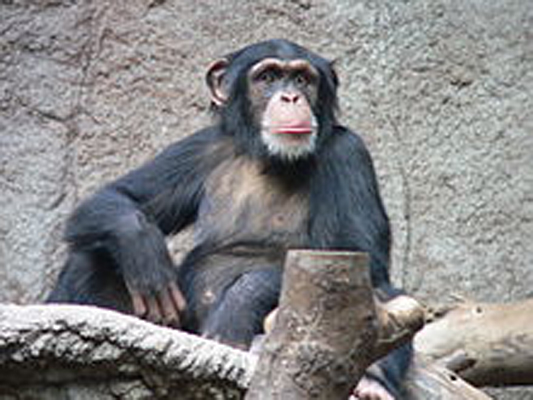
Both chimpanzees and humans spontaneously imitate each other's actions, says study
Imitation is therefore viewed as the key cognitive ability that enabled human culture to grow and create such things as language, technology, art and science.
Decades of research has shown that apes, in spite of their proverbial aping abilities, are rather poor imitators, especially when compared to human children. The imitative superiority of children has been attributed to a higher social motivation to engage others in communication and the sharing of experiences. Current theories hold that apes are worse imitators because they lack this social and communicative side of imitation. The studies behind these theories, however, have focused on imitation in the area of learning solutions to physical problems.
A new study from Lund University, published in the journal Primates, has instead targeted the interactive side of imitation directly, and finds that the divide between humans and chimpanzees is less clear cut. By systematically observing the spontaneous interactions between zoo visitors and chimpanzees at Furuvik Zoo in Sweden, researchers found that both species imitated to a similar extent. About 10% of the actions produced by either species was an imitation of the other species' actions.
"This took place in a typical zoo setting, where both chimpanzees and visitors tries to attract each other's interest in various ways. We studied these interactions", explains Dr. Tomas Persson, one of the researchers who conducted the study.
There was also significant overlap in the type of actions imitated by the two species. Both humans and chimpanzees imitated common actions, such as hand clapping and kissing or knocking on windows.
"The actions that were copied by both humans and chimpanzees were neither novel nor original and suggest that imitation was not at all about learning. The goal seemed to be purely social and communicative in nature", says Persson.
The results also show that interactions that included imitation lasted longer than those without imitation. Imitation of simple gestures was thus a good way to initiate contact and keep the interaction going.
"Several times we observed prolonged interactions that took on a game-like back-and-forth character, which is reminiscent of how preverbal toddlers interact by way of imitating other's play actions" says Dr. Gabriela-Alina Sauciuc, who conducted the study together with Persson.
The study is the first to systematically investigate spontaneous imitation between zoo chimpanzees and zoo visitors, and to highlight the social and communicative role that the imitation of familiar, routine actions may acquire during such interactions. The findings suggest that intentional imitation in ape evolution might have evolved for communicative and affiliative purposes, besides the more widely acknowledged learning function of imitation.
Image:wikimedia commons
Support Our Journalism
We cannot do without you.. your contribution supports unbiased journalism
IBNS is not driven by any ism- not wokeism, not racism, not skewed secularism, not hyper right-wing or left liberal ideals, nor by any hardline religious beliefs or hyper nationalism. We want to serve you good old objective news, as they are. We do not judge or preach. We let people decide for themselves. We only try to present factual and well-sourced news.
Support objective journalism for a small contribution.


