
April 06, 2026 12:47 am (IST)
Follow us:
facebook-white sharing button
twitter-white sharing button
instagram-white sharing button
youtube-white sharing button
‘Not denied a ticket’: Annamalai explains absence from BJP’s Tamil Nadu candidate list | ‘Ghar-wapsi soon’: PoK wants to return to India, claims Imam organisation chief | Kerala polls shocker: Tharoor’s convoy stopped, security guard attacked mid-campaign | AAP drops Raghav Chadha from key parliamentary role, sparks buzz over internal rift | Amit Shah to camp in West Bengal for 15 days during Assembly polls; predicts Mamata’s defeat in state and Bhabanipur | 'BJP plotting President’s Rule, don’t fall in the trap': Mamata Banerjee on Malda unrest, urges peace | 'Most polarised state': CJI Kant raps Bengal govt over 9-hour hostage of judicial officers | Bengal SIR protest: Judge pleads for help amid mob attack after 9-hour hostage ordeal | Bengal SIR progress: 47 lakh of 60 lakh adjudicated cases disposed of, Supreme Court informed | Amit Shah to join Suvendu Adhikari on Bhabanipur nomination day; BJP plans mega roadshow

Hubble sweeps scattered stars in Sagittarius

| | Jun 18, 2016, at 09:45 pm
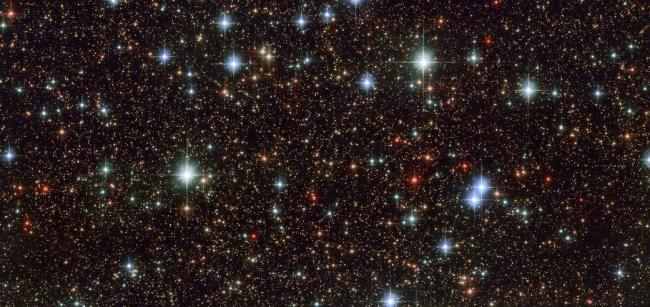
California, June 18 (IBNS) This colorful and star-studded view of the Milky Way galaxy was captured when the NASA/ESA Hubble Space Telescope pointed its cameras towards the constellation of Sagittarius (The Archer). Blue stars can be seen scattered across the frame, set against a distant backdrop of red-hued cosmic companions. This blue litter most likely formed at the same time from the same collapsing molecular cloud.

The color of a star can reveal many of its secrets. Shades of red indicate a star much cooler than the sun, so either at the end of its life, or much less massive. These lower-mass stars are called red dwarfs and are thought to be the most common type of star in the Milky Way. Similarly, brilliant blue hues indicate hot, young, or massive stars, many times the mass of the sun.

A star’s mass decides its fate; more massive stars burn brightly over a short lifespan, and die young after only tens of millions of years. Stars like the sun typically have more sedentary lifestyles and live longer, burning for approximately ten billion years. Smaller stars, on the other hand, live life in the slow lane and are predicted to exist for trillions of years, well beyond the current age of the universe.

Image credit: ESA/NASA

Support Our Journalism

We cannot do without you.. your contribution supports unbiased journalism

IBNS is not driven by any ism- not wokeism, not racism, not skewed secularism, not hyper right-wing or left liberal ideals, nor by any hardline religious beliefs or hyper nationalism. We want to serve you good old objective news, as they are. We do not judge or preach. We let people decide for themselves. We only try to present factual and well-sourced news.

Support objective journalism for a small contribution.