


 Air Pollution
Kolkata’s air quality slips into ‘very poor’ zone as winter pollution peaks, data shows
Kolkata/IBNS: Kolkata’s air quality has deteriorated sharply this winter, with official monitoring data showing repeated episodes of “very poor” air quality across key parts of the city, even as the issue remains largely absent from political discourse ahead of the West Bengal Assembly elections.
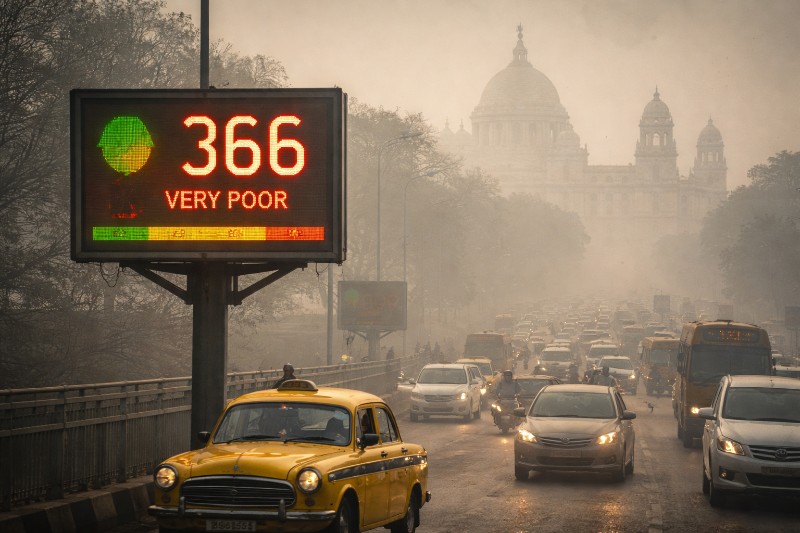
Real-time air-quality data from government monitoring stations indicate that areas around the Victoria Memorial and central Kolkata recorded alarming PM2.5 levels during December.
On December 12, the city’s Air Quality Index (AQI) peaked at 366, placing it firmly in the “very poor” category, according to data tracked by pollution monitoring agencies.
Visibility across major corridors, including the Maa Flyover stretch between Park Circus and the EM Bypass, has dropped significantly during morning hours, a sign of dense particulate pollution rather than seasonal fog.
Environmental experts attribute this winter deterioration to a combination of resuspended road dust, construction activity, dry soil conditions, and temperature inversion that traps pollutants close to ground level.
International air-quality tracker IQAir, in its 2024 global assessment, reported Kolkata’s annual average PM2.5 concentration at 45.6 micrograms per cubic metre — nearly nine times higher than the World Health Organisation’s recommended limit of 5 µg/m³.
The ranking places Kolkata as India’s second-most-polluted metropolitan city for the year.
Further analysis by environmental publication Down To Earth found that PM2.5 concentrations crossed 70 µg/m³ on nearly 75 percent of winter days, a level at which toxicity risks increase sharply.
Despite these figures, air pollution has not emerged as a major public or political issue in the state.
A source-apportionment study conducted by CSIR-NEERI and commissioned by the West Bengal Pollution Control Board (WBPCB) in 2019 identified secondary aerosols as the largest contributor to wintertime PM2.5 levels in Kolkata, accounting for 32 percent of fine particulate matter.
Vehicular emissions contributed 25 percent, followed by wood burning at 15 percent and coal combustion at nine percent.
Secondary aerosols form when gases such as ammonia and nitrogen oxides react in the atmosphere, making them difficult to control through surface-level measures.
Experts note that such pollution cannot be addressed by mechanical cleaning alone and requires regulation of fuel use, vehicular emissions, industrial activity and waste burning.
While civic authorities periodically deploy water sprinklers, anti-smog guns and sweeping drives — particularly ahead of high-profile events — environmental assessments indicate these interventions offer only temporary relief.
The World Bank has previously cautioned that city-level actions without regional coordination will have limited impact, especially in densely populated urban clusters.
Governance responsibility for air quality remains fragmented.
The central government places primary accountability on state administrations, while states often cite transboundary pollution inflows.
Municipal bodies, meanwhile, point to jurisdictional limitations. This diffusion of responsibility has slowed sustained enforcement, experts say.
Multiple studies have consistently recommended integrated air-shed management for Kolkata and neighbouring Howrah, stricter monitoring of construction dust, phased removal of older vehicles, curbs on open burning, and transparent publication of enforcement data.
However, implementation has remained uneven.
As winter pollution intensifies, environmental data shows Kolkata’s air quality crisis continuing largely outside the electoral conversation, despite worsening health indicators and repeated scientific warnings.
Support Our Journalism
We cannot do without you.. your contribution supports unbiased journalism
IBNS is not driven by any ism- not wokeism, not racism, not skewed secularism, not hyper right-wing or left liberal ideals, nor by any hardline religious beliefs or hyper nationalism. We want to serve you good old objective news, as they are. We do not judge or preach. We let people decide for themselves. We only try to present factual and well-sourced news.
Support objective journalism for a small contribution.


