


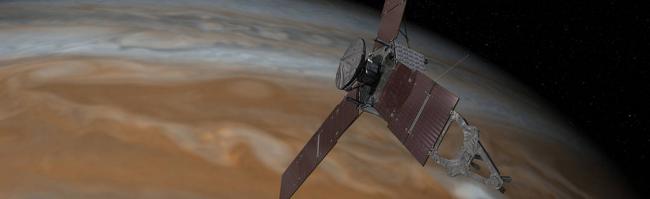
NASA's Juno Mission exits safe mode, performs trim maneuver
Mission controllers commanded Juno to exit safe mode Monday, Oct. 24, with confirmation of safe mode exit received on the ground at 10:05 a.m. PDT (1:05 p.m. EDT), read the NASA website.
The spacecraft entered safe mode on Oct. 18 when a software performance monitor induced a reboot of the spacecraft's onboard computer. The team is still investigating the cause of the reboot and assessing two main engine check valves.
"Juno exited safe mode as expected, is healthy and is responding to all our commands,” said Rick Nybakken, Juno project manager from NASA's Jet Propulsion Laboratory in Pasadena, California. "We anticipate we will be turning on the instruments in early November to get ready for our December flyby."
In preparation for that close flyby of Jupiter, Juno executed an orbital trim maneuver Tuesday at 11:51 a.m. PDT (2:51 p.m. EDT) using its smaller thrusters.
The burn, which lasted just over 31 minutes, changed Juno’s orbital velocity by about 5.8 mph (2.6 meters per second) and consumed about 8 pounds (3.6 kilograms) of propellant.
Juno will perform its next science flyby of Jupiter on Dec. 11, with time of closest approach to the gas giant occurring at 9:03 a.m. PDT (12:03 p.m. EDT). The complete suite of Juno’s science instruments, as well as the JunoCam imager, will be collecting data during the upcoming flyby.
“We are all excited and eagerly anticipating this next pass close to Jupiter,” said Scott Bolton, principal investigator of Juno from the Southwest Research Institute in San Antonio. “The science collected so far has been truly amazing."
The Juno spacecraft launched on Aug. 5, 2011, from Cape Canaveral, Florida, and arrived at Jupiter on July 4, 2016.
During its mission of exploration, Juno soars low over the planet's cloud tops -- as close as about 2,600 miles (4,100 kilometers).
During these flybys, Juno probes beneath the obscuring cloud cover of Jupiter and studies its auroras to learn more about the planet's origins, structure, atmosphere and magnetosphere.
Image: NASA
Support Our Journalism
We cannot do without you.. your contribution supports unbiased journalism
IBNS is not driven by any ism- not wokeism, not racism, not skewed secularism, not hyper right-wing or left liberal ideals, nor by any hardline religious beliefs or hyper nationalism. We want to serve you good old objective news, as they are. We do not judge or preach. We let people decide for themselves. We only try to present factual and well-sourced news.
Support objective journalism for a small contribution.


