


 The Nobel Prize
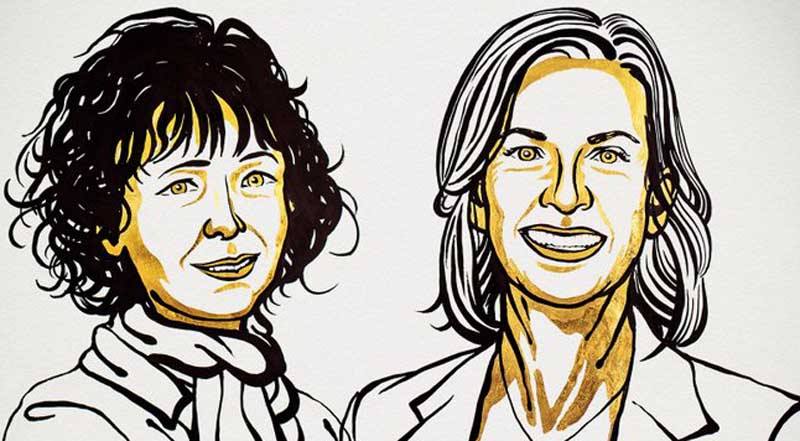
Nobel Prize in Chemistry awarded to Emmanuelle Charpentier and Jennifer A. Doudna
Stockholm: The Royal Swedish Academy of Sciences on Wednesday awarded Nobel Prize in chemistry to French scientist Emmanuelle Charpentier and American Jennifer A. Doudna.
The prestigious award was given to them for discovering one of gene technology’s sharpest tools- CRISPR/Cas9 genetic scissors.
Using these, researchers can change the DNA of animals, plants and microorganisms with extremely high precision, read the official website.
This technology has had a revolutionary impact on the life sciences, is contributing to new cancer therapies and may make the dream of curing inherited diseases come true.
Researchers need to modify genes in cells if they are to find out about life’s inner workings. This used to be time-consuming, difficult and sometimes impossible work. Using the CRISPR/Cas9 genetic scissors, it is now possible to change the code of life over the course of a few weeks.
“There is enormous power in this genetic tool, which affects us all. It has not only revolutionised basic science, but also resulted in innovative crops and will lead to ground-breaking new medical treatments,” says Claes Gustafsson, chair of the Nobel Committee for Chemistry.
As so often in science, the discovery of these genetic scissors was unexpected. During Emmanuelle Charpentier’s studies of Streptococcus pyogenes, one of the bacteria that cause the most harm to humanity, she discovered a previously unknown molecule, tracrRNA.
Her work showed that tracrRNA is part of bacteria’s ancient immune system, CRISPR/Cas, that disarms viruses by cleaving their DNA.
Charpentier published her discovery in 2011.
The same year, she initiated a collaboration with Jennifer Doudna, an experienced biochemist with vast knowledge of RNA.
Together, they succeeded in recreating the bacteria’s genetic scissors in a test tube and simplifying the scissors’ molecular components so they were easier to use.
In an epoch-making experiment, they then reprogrammed the genetic scissors. In their natural form, the scissors recognise DNA from viruses, but Charpentier and Doudna proved that they could be controlled so that they can cut any DNA molecule at a predetermined site. Where the DNA is cut it is then easy to rewrite the code of life.
Since Charpentier and Doudna discovered the CRISPR/Cas9 genetic scissors in 2012 their use has exploded.
This tool has contributed to many important discoveries in basic research, and plant researchers have been able to develop crops that withstand mould, pests and drought.
In medicine, clinical trials of new cancer therapies are underway, and the dream of being able to cure inherited diseases is about to come true.
These genetic scissors have taken the life sciences into a new epoch and, in many ways, are bringing the greatest benefit to humankind.
Support Our Journalism
We cannot do without you.. your contribution supports unbiased journalism
IBNS is not driven by any ism- not wokeism, not racism, not skewed secularism, not hyper right-wing or left liberal ideals, nor by any hardline religious beliefs or hyper nationalism. We want to serve you good old objective news, as they are. We do not judge or preach. We let people decide for themselves. We only try to present factual and well-sourced news.
Support objective journalism for a small contribution.


