


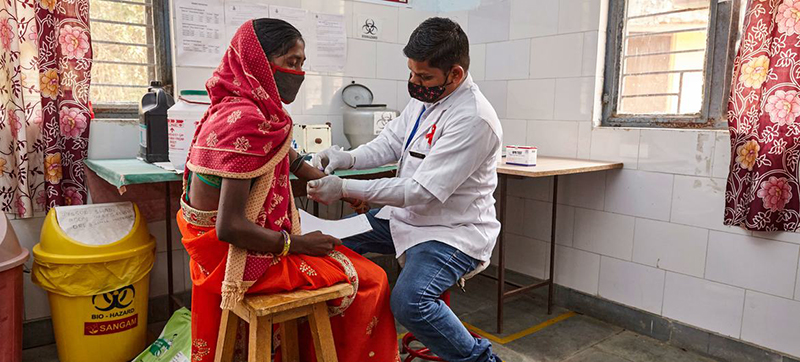
 AIDS
AIDS
World must ‘speed up’ efforts to end AIDS pandemic by 2030
New York: To end AIDS, beat COVID-19 and “stop the pandemics of the future”, the world needs to ensure global access to lifesaving health technologies, the UN Chef de Cabinet has told a meeting of the General Assembly to review progress.
The AIDS pandemic continues to be responsible for more than 13,000 deaths every week.
Yet, one year after adopting a political declaration on HIV and AIDS: Ending Inequalities and Getting on Track to End AIDS by 2030, data from UNAIDS shows that HIV infections and AIDS-related deaths are not currently declining fast enough to end the pandemic in eight years, as Member States have pledged to do.
Member States have highlighted the need to “work together to speed up progress on implementation,” said the UN agency.
Tackling inequalities
In advance of the meeting, Secretary-General António Guterres released a report on implementing the HIV/AIDS political declaration entitled Tackling inequalities to end the AIDS pandemic.
The report sets out how inequalities and insufficient investment “leave the world dangerously underprepared to confront the pandemics of today and tomorrow.”
It also highlights solutions, including HIV prevention and societal enablers; community-led responses; equitable access to medicines, vaccines, and health technologies; sustainable financing for AIDS and pandemic response; and the need to strengthen global partnerships.
Getting on the path
Representing the UN chief, Chef de Cabinet, Courtenay Rattray, outlined three immediate steps to reverse current trends and get back on track.
“First, we need to tackle intersecting inequalities, discrimination and the marginalization of entire communities, which are often exacerbated by punitive laws, policies and practices,” he said, calling for policy reforms to reduce the HIV risks for marginalized communities – including sex workers, people who inject drugs, prisoners, transgender people and gay men.
The Chef de Cabinet pointed out how stigmatization obstructs public health while “social solidarity protects everyone”.
Invest in global health
The second step was to share health technologies, including antiretrovirals, and make them available to people in all countries throughout the world.
Thirdly, more resources must be committed: “Investments in AIDS are investments in global health security. They save lives – and money,” he said.
Investments in AIDS are investments in global health security -- UN chief
Meeting the targets
General Assembly President Abdulla Shahid noted that equal access to healthcare is “an essential human right to guarantee public health, for all.”
“Striving to achieve the 2025 AIDS targets is an opportunity to work together to increase investments towards public health systems and pandemic responses, and to draw on the hard-learnt lessons from the HIV/AIDS crisis for our recovery from COVID-19, and vice versa”, he said.
According to the political declaration, released last June, if the international community reaches the targets, 3.6 million new HIV-infections and 1.7 million AIDS-related deaths will be prevented by 2030.
It calls on countries to provide 95 per cent of all at-risk people with access to preventative care, and for countries to ensure that 95 per cent of HIV-positive citizens are aware of their HIV status.
The 95 per cent of those who know their status, should also have access to HIV treatment, according to the declaration.
Prioritizing collective action
Statements on behalf of the Africa Group in the General Assembly, the Caribbean Community and Central American Integration System, and European Union, all emphasized the urgency of stepping up collective action and rooting out inequality, to ensure a successful HIV response.
And the Africa Group and others spoke about addressing discriminatory laws that keep people from accessing healthcare and social services.
Support Our Journalism
We cannot do without you.. your contribution supports unbiased journalism
IBNS is not driven by any ism- not wokeism, not racism, not skewed secularism, not hyper right-wing or left liberal ideals, nor by any hardline religious beliefs or hyper nationalism. We want to serve you good old objective news, as they are. We do not judge or preach. We let people decide for themselves. We only try to present factual and well-sourced news.
Support objective journalism for a small contribution.


