October 14, 2026 01:33 am (IST)

Follow us:


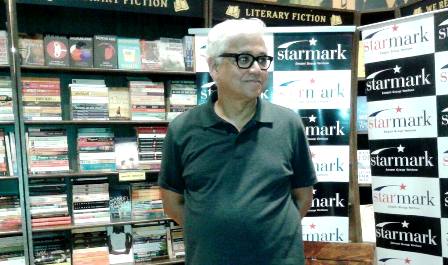
Flood of Fire has special connection with Calcutta: Amitav Ghosh
Kolkata, June 8 (IBNS): Having concluded his Ibis trilogy with the release of "Flood of Fire", Amitav Ghosh, one of the best-selling Indian writers in English, said his next work would be much shorter.
“I think my next few books will be much shorter," said the writer on Sunday at the book signing event at the Starmark bookstore here as his fans queued up to get initialed their copies of Flood of Fire, presented by Penguin Books India.
Flood of Fire, released earlier at the Indian Museum, is the final part of his historical fiction series Ibis Trilogy. The other two books of the trilogy are Sea of Poppies (2008) and River of Smoke (2011).
While the first volume "Sea of Poppies" dwelt on the inner workings of the Opium trade in British India, "River of Smoke" is about the changing lives and traditions of Indian migrants in Mauritius and the opium trade in China.
In "Flood of Fire", Ghosh goes back to 1839 when tension had been rapidly mounting between China and British India following the crackdown on opium smuggling by Beijing.
At the start of the signing, Ghosh introduced his book to the audience. "The Ibis Trilogy, set in the 1830’s and 1840’s, covers the events of the First Opium War, of which Calcutta was the nerve centre,” said the author.
“This is a book which has a very special connection with Calcutta, a lot of the action actually happens in Calcutta”, said Ghosh.
A short question-answer session followed, where Ghosh revealed that he had developed an interest in the history of opium and poppies with relation to India, when he began writing the first installment of the trilogy. “The importance of this war is immeasurable,”, he said, adding that “this was where modern Asia was born.”
Ghosh then proceeded with the signing, with fans of all ages from school-going children to senior citizens, flocking to him to get their books signed.
(Reporting by Ruchita Chatterji)
Support Our Journalism
We cannot do without you.. your contribution supports unbiased journalism
IBNS is not driven by any ism- not wokeism, not racism, not skewed secularism, not hyper right-wing or left liberal ideals, nor by any hardline religious beliefs or hyper nationalism. We want to serve you good old objective news, as they are. We do not judge or preach. We let people decide for themselves. We only try to present factual and well-sourced news.
Support objective journalism for a small contribution.


Latest Headlines
Kolkata culturist Sundeep Bhutoria inaugurates India National Stand at Frankfurt Book Fair 2026
Fri, Oct 09 2026
‘Bold and inventive’: Canadian poet Anne Carson wins 2026 Nobel Prize in Literature
Thu, Oct 08 2026
‘We are the worst storytellers’: Suhel Seth on India’s failure to market itself at 'Kitaab' book launch
Mon, Sep 07 2026
Padma Shri Mukesh Batra launches ‘TOXIC’, explores overlooked forms of modern-day toxicity
Mon, Aug 24 2026
Padma Shri Mukesh Batra launches ‘TOXIC’, explores overlooked forms of modern-day toxicity
Mon, Aug 24 2026