All about time capsule with detailed history of Ram Janmabhoomi to be placed 2,000 ft under Ayodhya Ram Mandir
Ayodhya: The Ram Janmabhoomi Teerth Kshetra Trust plans to put a 'Time Capsule', containing a detailed account of the history of the Ram Janmabhoomi, at a depth of 2,000 feet beneath the 'Ram Mandir' in Ayodhya, media reports said.
According to Trust members, the decision to place the capsule below the site is a well-thought-out measure aimed at preventing potential future disputes regarding the area.
Also Read Live Blog: Ayodhya's grand Ram Mandir inauguration
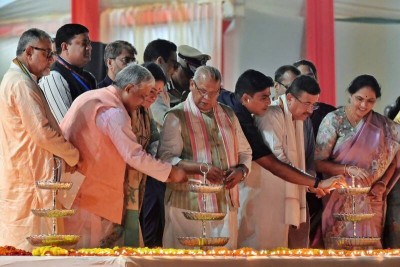
 Photo Courtesy: Shri Ram Janmbhoomi Teerth Kshetra
It is a proactive step to prevent any disputes related to various aspects of the historical narrative of the 'Ram Temple' and to fulfill an educational purpose.
A time capsule works as a repository of historical information, serving as a means of communication with future generations and providing information to archaeologists or historians in their research.
 Photo Courtesy: Shri Ram Janmbhoomi Teerth Kshetra
With the help of the time capsules, future generations can access insights into specific eras, societies, and countries. Usually, these capsules are embedded in the foundations of buildings.
The time capsule is set to convey a message in Sanskrit about Ayodhya, Lord Ram, and his birthplace. This message will be inscribed on a copper plate, known as 'Tamra Patras,' before being placed below the site.
The Trust opted for Sanskrit due to its conciseness, allowing for the expression of extensive content in a few words.
It's important to mention that the time capsule won't be buried on the day of Bhoomi Poojan, as it requires preparation time. Experts have been engaged to craft precise content with minimal words.
Constructed from metals like aluminum, stainless steel, or copper, the time capsule employs acid-free paper to ensure longevity, preventing decay even after millennia. The 3-foot-long capsule container will be deeply buried in the ground.
On November 30, 2017, a 400-year-old time capsule containing economic, political, and cultural information from the year 1777 was found inside the statue of Jesus Christ in Burgos, Spain.
According to experts, this is the oldest known time capsule to date.
The Shri Ram Janmabhoomi Teerth Kshetra temple trust has sent invitations to over 7,000 people, including politicians, Bollywood celebrities, cricketers, industrialists, and others.
Support Our Journalism
We cannot do without you.. your contribution supports unbiased journalism
IBNS is not driven by any ism- not wokeism, not racism, not skewed secularism, not hyper right-wing or left liberal ideals, nor by any hardline religious beliefs or hyper nationalism. We want to serve you good old objective news, as they are. We do not judge or preach. We let people decide for themselves. We only try to present factual and well-sourced news.
Support objective journalism for a small contribution.