Allison and Honjo win 2018 Nobel Prize in Medicine for cancer research
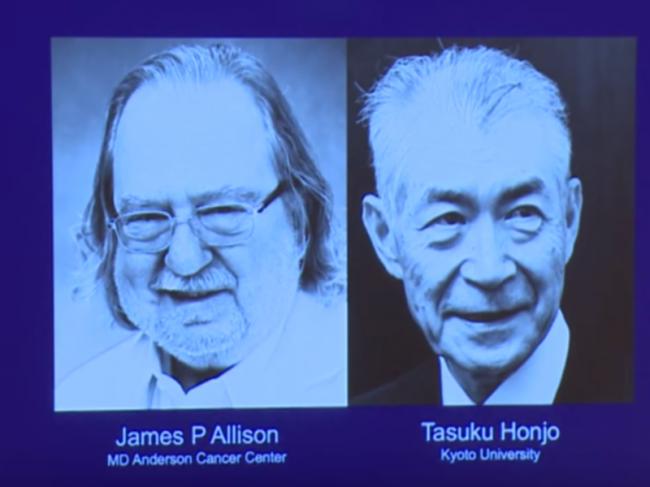
Stockholm, Oct 1 (IBNS): James P. Allison and Tasuku Honjo won the 2018 Nobel Prize in Medicine for their discovery of cancer therapy by inhibition of negative immune regulation.
Allison is the professor at the University of Texas MD Anderson Cancer Center in the United States.
Honjo is a professor at Kyoto University since 1984.
The Nobel Assembly at Karolinska Institutet has decided to award the Nobel to Allison and Honjo.
The two have shown how different strategies for inhabiting the brakes on the immune system can be used in the treatment of cancer.
Their discoveries are a landmark in our fight against cancer.
Already 150 years ago attempts were made to use infectious agents to stimulate immune responses to cancer. Since then many seminal discoveries in the fields of basic immunology and tumor biology, including some awarded with the Nobel Prize, enabled a deeper understanding of such processes.
In 1996, James P. Allison and coworkers used this accumulated knowledge to demonstrate that antibodies directed against a cell surface molecule on T cells, CTLA-4, is capable of unleashing an immune response, which cured mice from tumors. Prior to this, in the laboratory of Tasuku Honjo, a new molecule named PD-1 had been identified. Similar to CTLA-4, PD-1 also serves as a brake, which can prevent T cells from killing cancer cells.
With the aid of biomedical companies Allison succeeded in developing the new concept with anti-CTLA-4 into clinical therapy for patients with advanced forms of melanoma.
The use of antibodies directed against PD-1 and its ligand PD-L1 has now been approved for several cancer forms and this treatment is even more efficacious. The best clinical results have so far been obtained by combining treatment with anti-CTLA-4 and antiPD-1. These antibodies are known as immune checkpoint inhibitors and the seminal discoveries by the two laureates have added a new pillar for the treatment of cancer.
According to WHO, more than 18 million persons in the world are estimated to be diagnosed with cancer in 2018 (Global Cancer Observatory, 2018).
Scientific discoveries have paved the way for better understanding of the disease, as well as for novel treatments.
Image: Screen grab from Youtube/nobelprize.org
Support Our Journalism
We cannot do without you.. your contribution supports unbiased journalism
IBNS is not driven by any ism- not wokeism, not racism, not skewed secularism, not hyper right-wing or left liberal ideals, nor by any hardline religious beliefs or hyper nationalism. We want to serve you good old objective news, as they are. We do not judge or preach. We let people decide for themselves. We only try to present factual and well-sourced news.
Support objective journalism for a small contribution.