April 05, 2026 01:50 pm (IST)

Follow us:


APJ Abdul Kalam passes away
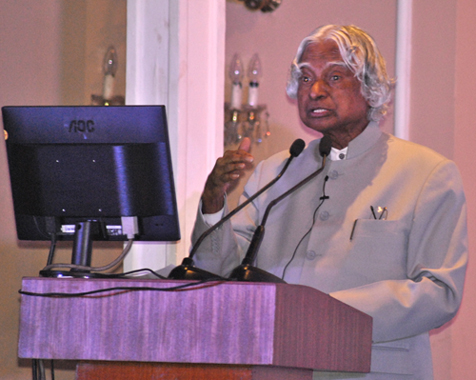
New Delhi, July 27 (IBNS) Former Indian president APJ Abdul Kalam, who is also known for his contribution in the field of nuclear science, passed away at a hospital in Meghalaya's capital Shillong on Monday.
He was 83 when he breathed his last at the hospital where he was admitted after he collapsed during a lecture at the Indian Institute of Management (IIM) in Shillong.
According to reports, he died due to a cardiac arrest.
An eminent Indian scientist, Kalam had served as the 11th President of India.
Born on Oct 15, 1931 at Rameswaram in Tamil Nadu, Avul Pakir Jainulabdeen Abdul Kalam, specialized in Aeronautical Engineering from Madras Institute of Technology.
Conforming his death, Union Home Minister Rajnath Singh tweeted: "Deeply saddened at the sudden demise of the former president of India Dr. APAJ Abdul Kalam. He was an inspiration to an entire generation."
"Dr. Kalam was a man of impeccable character, indomitable spirit, profound knowledge and firm conviction," he said.
"The death of Dr. Kalam is an irreparable loss to this nation. He has left a big void hard to fill. I deeply mourn his death. RIP Kalam Sahab," the Minister said.
Kalam made significant contribution as Project Director to develop India's first indigenous Satellite Launch Vehicle (SLV-III) which successfully injected the Rohini satellite in the near earth orbit in July 1980 and made India an exclusive member of Space Club.
He was responsible for the evolution of ISRO's launch vehicle programme, particularly the PSLV configuration. After working for two decades in ISRO and mastering launch vehicle technologies, Kalam took up the responsibility of developing Indigenous Guided Missiles at Defence Research and Development Organisation as the Chief Executive of Integrated Guided Missile Development Programme (IGMDP).
He was responsible for the development and operationalisation of AGNI and PRITHVI Missiles and for building indigenous capability in critical technologies through networking of multiple institutions.
He was the Scientific Adviser to Defence Minister and Secretary, Department of Defence Research & Development from July 1992 to December 1999. During this period he led to the weaponisation of strategic missile systems and the Pokhran-II nuclear tests in collaboration with Department of Atomic Energy, which made India a nuclear weapon State. He also gave thrust to self-reliance in defence systems by progressing multiple development tasks and mission projects such as Light Combat Aircraft.
Kalam took up academic pursuit as Professor, Technology & Societal Transformation at Anna University, Chennai from November 2001 and was involved in teaching and research tasks.
Above all he took up a mission to ignite the young minds for national development by meeting high school students across the country.
In his literary pursuit four of Dr. Kalam's books - "Wings of Fire", "India 2020 - A Vision for the New Millennium", "My journey" and "Ignited Minds - Unleashing the power within India".
Kalam is one of the most distinguished scientists of India with the unique honour of receiving honorary doctorates from 30 universities and institutions.
He has been awarded the coveted civilian awards - Padma Bhushan (1981) and Padma Vibhushan (1990) and the highest civilian award Bharat Ratna (1997).
He had served as the 11th President of India on from July 25, 2002- July 25, 2007.
According to reports, he died due to a cardiac arrest.
An eminent Indian scientist, Kalam had served as the 11th President of India.
Born on Oct 15, 1931 at Rameswaram in Tamil Nadu, Avul Pakir Jainulabdeen Abdul Kalam, specialized in Aeronautical Engineering from Madras Institute of Technology.
Conforming his death, Union Home Minister Rajnath Singh tweeted: "Deeply saddened at the sudden demise of the former president of India Dr. APAJ Abdul Kalam. He was an inspiration to an entire generation."
"Dr. Kalam was a man of impeccable character, indomitable spirit, profound knowledge and firm conviction," he said.
"The death of Dr. Kalam is an irreparable loss to this nation. He has left a big void hard to fill. I deeply mourn his death. RIP Kalam Sahab," the Minister said.
Kalam made significant contribution as Project Director to develop India's first indigenous Satellite Launch Vehicle (SLV-III) which successfully injected the Rohini satellite in the near earth orbit in July 1980 and made India an exclusive member of Space Club.
He was responsible for the evolution of ISRO's launch vehicle programme, particularly the PSLV configuration. After working for two decades in ISRO and mastering launch vehicle technologies, Kalam took up the responsibility of developing Indigenous Guided Missiles at Defence Research and Development Organisation as the Chief Executive of Integrated Guided Missile Development Programme (IGMDP).
He was responsible for the development and operationalisation of AGNI and PRITHVI Missiles and for building indigenous capability in critical technologies through networking of multiple institutions.
He was the Scientific Adviser to Defence Minister and Secretary, Department of Defence Research & Development from July 1992 to December 1999. During this period he led to the weaponisation of strategic missile systems and the Pokhran-II nuclear tests in collaboration with Department of Atomic Energy, which made India a nuclear weapon State. He also gave thrust to self-reliance in defence systems by progressing multiple development tasks and mission projects such as Light Combat Aircraft.
Kalam took up academic pursuit as Professor, Technology & Societal Transformation at Anna University, Chennai from November 2001 and was involved in teaching and research tasks.
Above all he took up a mission to ignite the young minds for national development by meeting high school students across the country.
In his literary pursuit four of Dr. Kalam's books - "Wings of Fire", "India 2020 - A Vision for the New Millennium", "My journey" and "Ignited Minds - Unleashing the power within India".
Kalam is one of the most distinguished scientists of India with the unique honour of receiving honorary doctorates from 30 universities and institutions.
He has been awarded the coveted civilian awards - Padma Bhushan (1981) and Padma Vibhushan (1990) and the highest civilian award Bharat Ratna (1997).
He had served as the 11th President of India on from July 25, 2002- July 25, 2007.
Support Our Journalism
We cannot do without you.. your contribution supports unbiased journalism
IBNS is not driven by any ism- not wokeism, not racism, not skewed secularism, not hyper right-wing or left liberal ideals, nor by any hardline religious beliefs or hyper nationalism. We want to serve you good old objective news, as they are. We do not judge or preach. We let people decide for themselves. We only try to present factual and well-sourced news.
Support objective journalism for a small contribution.


Latest Headlines
India turns to Iranian oil for the first time in 7 years as Hormuz disruption squeezes global supply
Sun, Apr 05 2026
300 sign up in a day: Government’s big push to save Parsi population gains momentum
Sat, Apr 04 2026
CDS Anil Chauhan reviews operational readiness of Chinar Corps, underlines imperative of jointness and multi-domain preparedness
Sat, Apr 04 2026
Kerala polls shocker: Tharoor’s convoy stopped, security guard attacked mid-campaign
Sat, Apr 04 2026
‘Not denied a ticket’: Annamalai explains absence from BJP’s Tamil Nadu candidate list
Sat, Apr 04 2026