India, UAE to build energy hub in Sri Lanka's Trincomalee amid China rivalry
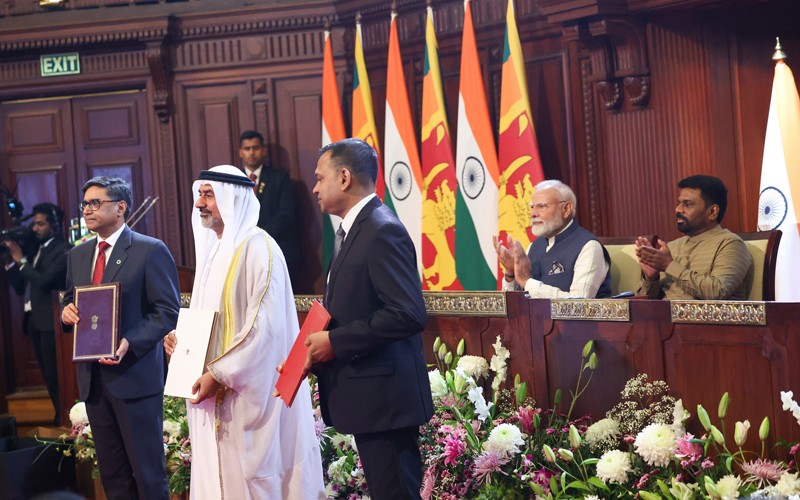
Colombo/New Delhi: India and the United Arab Emirates have signed an agreement to jointly develop an energy hub in Sri Lanka, the Ministry of External Affairs said on Saturday, underscoring New Delhi’s efforts to strengthen its regional foothold as it faces growing competition from China in the island nation, according to a Reuters report.
The tripartite agreement was formalised during Prime Minister Narendra Modi’s visit to Colombo — the first by a world leader since Sri Lankan President Anura Kumara Dissanayake assumed office in September.
India has been working closely with Sri Lanka to expand cooperation, especially after extending $4 billion in financial support during the country's 2022 economic collapse.
The new agreement intensifies India’s strategic contest with China, which has made significant inroads in Sri Lanka, including a $3.2-billion refinery project by Chinese state energy firm Sinopec in Hambantota.
The planned energy hub will be located in Trincomalee, a key eastern port city known for its natural harbour.
The project will involve building a multi-product pipeline and may incorporate a World War II-era tank farm partially owned by the Sri Lankan subsidiary of Indian Oil Corporation, according to Foreign Secretary Vikram Misri.
“The UAE is a strategic partner for India in the energy space and therefore was an ideal partner for this exercise that is being done for the first time in the region,” Misri said. “The exact contours of UAE's role will be elaborated once the business-to-business discussions kick-off.”
Business entities from the three countries will be selected next to evaluate project feasibility and funding, Misri added.
During the visit, PM Modi also inaugurated a $100 million solar power plant developed jointly by India’s National Thermal Power Corp and the Ceylon Electricity Board.
Misri further said that India and Sri Lanka have completed the debt restructuring process.
As per data from Sri Lanka’s Finance Ministry, Colombo owes roughly $1.36 billion to India’s EXIM Bank and State Bank of India.
Sri Lanka initiated talks with its creditors after defaulting on its external debt in May 2022. A preliminary agreement with bilateral lenders — India, Japan and China — was signed in June last year.
Additionally, the two countries signed agreements on cross-border power grid connectivity, digital cooperation, security, and healthcare.
Support Our Journalism
We cannot do without you.. your contribution supports unbiased journalism
IBNS is not driven by any ism- not wokeism, not racism, not skewed secularism, not hyper right-wing or left liberal ideals, nor by any hardline religious beliefs or hyper nationalism. We want to serve you good old objective news, as they are. We do not judge or preach. We let people decide for themselves. We only try to present factual and well-sourced news.
Support objective journalism for a small contribution.