No more 'lost chastity', 'outraged modesty': Supreme Court pushes gender-sensitive court language
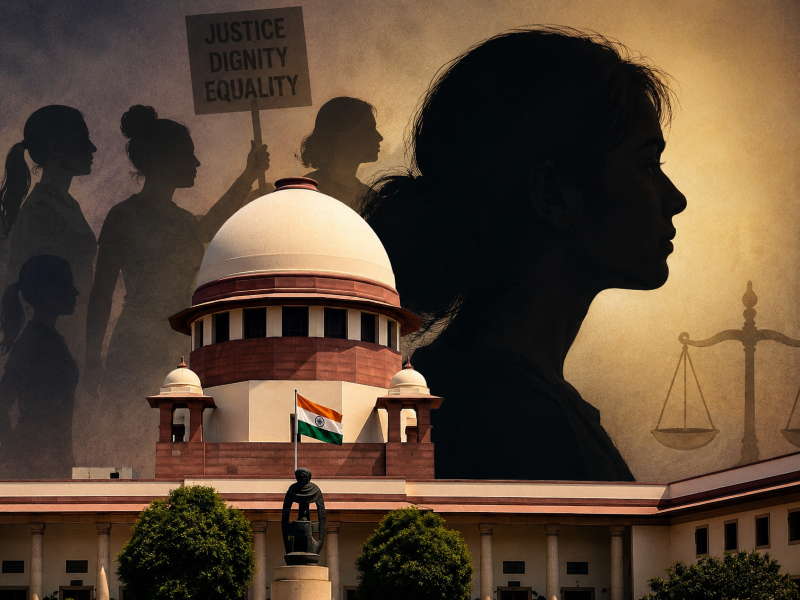
The Supreme Court has called for greater sensitivity in judicial writing in sexual offence cases, releasing a report that urges judges to abandon patriarchal and victim-blaming language in favour of survivor-centric, legally precise terminology.
The report, Judgments and Gender: Sensitivity and Compassion in Writing Judgments, was prepared by an expert committee headed by former Supreme Court judge Justice Aniruddha Bose after analysing 125 trial court judgments from across the country with assistance from State judicial academies.
It recommends replacing expressions such as "prosecutrix," "helpless woman," "lost her chastity," and "outraged her modesty" with neutral terms including "victim," "survivor," "complainant," "sexual assault," and "bodily autonomy."
Avoid stereotypes and victim-blaming: Report
The committee said the language used in judgments plays a crucial role in ensuring fairness, dignity and impartiality, and warned judges against relying on stereotypes or asking victim-blaming questions.
It also stressed that survivors should not be compelled to interact with the accused during court proceedings.
The report flagged concerns that judicial approaches in sexual assault cases involving unconscious women have, at times, reinforced "rape myths" by questioning the survivor's credibility instead of scrutinising the accused's conduct.
"Such language can re-traumatize survivors and reinforce social prejudice instead of promoting justice," the report said.
Words judges should stop using
The committee proposed replacing several expressions commonly found in court judgments.
For instance, it recommended using "violated the bodily autonomy of the complainant or victim" instead of "the body of women as playground," and "the survivor experienced harm or trauma" instead of phrases such as "victimisation" or "soul destroyed."
Judges were also advised to avoid descriptions such as "poor helpless minor girl," "fuelled by lust," "satisfy his illicit lust," "spoiled her childhood," "ruined life," and "haunt throughout her life."
According to the report, words such as "honour," "shame," "chastity," "bashfulness," and "sanctity" reflect patriarchal notions that tie a woman's worth to her sexual purity or family reputation.
Judicial reasoning, it said, should instead centre on consent, dignity, bodily autonomy and constitutional rights.
The report also noted that describing sexual assault as an act of "lust" wrongly suggests male sexual desire is uncontrollable and diminishes the gravity of the crime.
No adverse inference from delay or lack of injuries
The committee cautioned judges against drawing negative conclusions simply because a survivor delayed reporting the offence, had no visible injuries or did not physically resist.
"Absence of injuries, delayed reporting, or lack of resistance does not imply consent. Victims may respond differently to trauma," the report said, urging courts to avoid stereotypical assumptions about how survivors should behave.
Protect survivors during trial
The report asked trial judges to prevent humiliating or intrusive cross-examination, especially questions relating to a survivor's sexual history, clothing or conduct before the alleged offence.
It also recommended practical courtroom measures, including offering survivors a chair and water, clearing unnecessary people from the courtroom during testimony and remaining attentive to both verbal and non-verbal signs of distress.
"It is unpardonable and impermissible in any civilized society to judge a woman solely based on her clothing or to draw conclusions about her virtue or modesty," the committee observed.
The panel further recommended pre-trial counselling, in-camera proceedings, witness protection measures and legal assistance, stressing that judges should proactively ensure the safety of survivors and vulnerable witnesses rather than waiting for them to seek protection.
Report followed Allahabad High Court row
The committee was constituted following a Supreme Court judgment on February 10, 2026, which directed the formulation of guidelines to promote sensitivity in cases involving sexual offences and vulnerable persons.
The order came after the apex court took suo motu cognisance of a controversial Allahabad High Court ruling that had observed that grabbing a minor's breast and opening the drawstrings of her pyjamas would not amount to an attempt to rape.
Support Our Journalism
We cannot do without you.. your contribution supports unbiased journalism
IBNS is not driven by any ism- not wokeism, not racism, not skewed secularism, not hyper right-wing or left liberal ideals, nor by any hardline religious beliefs or hyper nationalism. We want to serve you good old objective news, as they are. We do not judge or preach. We let people decide for themselves. We only try to present factual and well-sourced news.
Support objective journalism for a small contribution.