 CAA
CAA
Supreme Court seeks Centre's response on plea to stay CAA rules; no interim stay
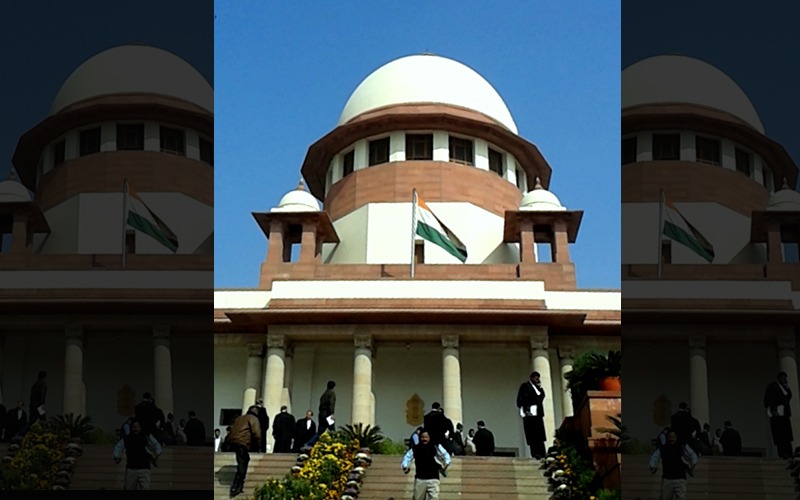
New Delhi/IBNS/UNI: The Supreme Court Tuesday sought a response from the Centre on the plea to stay the recently notified Citizenship (Amendment) rules of 2024 and asked it to file its reply by April 2.
A bench of Chief Justice of India (CJI) DY Chandrachud, Justice JB Pardiwala, and Justice Manoj Misra directed that the center should file its reply by April 2, and the submissions on the stay application to be filed before the court should not be more than five pages.
The court directed the respondents to file a 5-page reply to the government’s application by April 8.
The bench fixed April 9 as the next date of the hearing.
After the bench directed both parties to file their replies, heated arguments started in court.
Solicitor General Tushar Mehta sought four weeks to file the Centre’s response. To this, senior advocate Kapil Sibal argued that four weeks is far too much time to file the reply.
Sibal argued that if, by then, the government grants citizenship to some people under the CAA rules, then there are chances it cannot be reversed. He said that under international law, once citizenship is granted, it cannont be taken back.
Sibal also asked the Solicitor General,”What was the sudden urgency to notify the rules nearly four years after the CAA was passed?”
Senior Advocate Indira Jaising, also appearing for the petitioners, pressed that there should be a stay on the said Act and the government should undertake that it will not grant any citizenship under the rules while the matter is pending before the Court.
The SG replied, "Whether citizenship is granted or not, petitioners will not be impacted."
Senior Advocate Ranjit Kumar argued, "If a Hindu from Balochistan is granted citizenship, how is the petitioner affected?"
"They will get the right to vote!” Senior Advocate Jaising responded and asked the court to grant an interim stay on implementing the CAA Act.
CJI DY Chandrachud said, "But the infrastructure of the state-level committee is not yet ready."
It then directed that the matter be heard next on April 9.
The bench was hearing a batch of around 236 petitions concerning the Citizenship Amendment Act, 2019 (CAA) and the recently notified Citizenship (Amendment) Rules, 2024.
The bench directed that the proceedings be listed after three weeks and directed the central government to file the reply only in one case. Responses are not needed in all petitions, the court said. "A reply can oppose the interim prayer. We will keep this on April 9," the court ordered.
The CAA was passed by the Parliament on December 11, 2019, and got the president's assent the following day.
On the same day, the Indian Union Muslim League (IUML) moved the Supreme Court to challenge the Act. Subsequently, a large number of petitions came before the apex Court.
The CAA aims to grant citizenship to Hindus, Jains, Christians, Sikhs, Buddhists, and Parsis who arrived in India on or before December 31, 2014, from Bangladesh, Pakistan, and Afghanistan.
The CAA amends Section 2 of the Citizenship Act of 1955, which defines “illegal migrants."
It added a new proviso to Section 2(1)(b) of the Citizenship Act. As per the same, persons belonging to Hindu, Sikh, Buddhist, Jain, Parsi, or Christian communities from Afghanistan, Bangladesh, or Pakistan and who have been exempted by the Central government under the Passport (Entry into India) Act, 1920, or the Foreigners Act, 1946, shall not be treated as “illegal migrants." Consequently, such persons shall be eligible to apply for citizenship under the 1955 Act.
However, the law excluded the Muslim community from the provison, triggering protests across the country and a slew of petitions before the Supreme Court.
The petitioners challenging the law submitted that the CAA discriminates against Muslims based on religion. Such religious segregation is without any reasonable differentiation and violates the right to quality under Article 14, it was contended.
On December 18, 2019, the apex court issued a notice to the Union of India on that challenge.
However, the court did not stay the law since the rules were not notified, which meant that the act remained in limbo.
However, in a sudden move, the Centre notified the rules last week, on March 11, which effectively brought into force the CAA.
This led to a slew of applications before the Supreme Court seeking a stay on the Act and Rules, including those by the IUML, Assam Congress leader Debabrata Saikia, Asom Jatiyatabadi Yuba Chatra Parishad, the Democratic Youth Federation of India (DYFI), and the Social Democratic Party of India (SDPI).
The Court, however, refused to grant an interim stay on the CAA Act and the rules.
Support Our Journalism
We cannot do without you.. your contribution supports unbiased journalism
IBNS is not driven by any ism- not wokeism, not racism, not skewed secularism, not hyper right-wing or left liberal ideals, nor by any hardline religious beliefs or hyper nationalism. We want to serve you good old objective news, as they are. We do not judge or preach. We let people decide for themselves. We only try to present factual and well-sourced news.
Support objective journalism for a small contribution.