


Developing countries should not be liable for emissions ‘accumulated throughout history’, key UN development forum hears
New York, July 13 (IBNS): Citing climate change as being caused by “emissions accumulated throughout history”, the head of China’s Xiamen Airlines told the United Nations High-Level Political Forum on Sustainable Development (HLPF) in New York on Friday that heavy carbon dioxide emitters should “take on greater responsibility” to ameliorate the problem.
“As a representative of [the] aviation industry, we believe that it is very important to advance the ‘climate action’ of the Sustainable Development Goals [SDGs], and implement the Paris Agreement”, Zhao Dong said at Friday’s Discussion on SDG 13, climate action, citing that as the reason why two years ago he signed an agreement with the UN to make Xiamen “the first airlines in the world to support the SDGs”.
With the adoption of the historic 2030 Agenda for Sustainable Development and the 2015 Paris Agreement on climate change, world leaders agreed on an action blueprint to promote well-being and dignity for all on a healthy planet.
As climate change unfolds globally, temperature shifts, seasonal changes and increasingly extreme weather events threaten this vision.
With climate action intrinsically linked across all spheres of life on Earth, SDG 13 is fundamental in achieving all the other SDGs. Therefore, strategically increasing climate action through the Paris Agreement and 2030 Agenda and managing trade-offs would be synergistically decisive for achieving both agendas.
Aviation impact
The impacts of climate change, including extreme weather events, present challenges for travel and the aviation industry.
“I believe” Mr. Zhao stated, that “to reduce aviation emission globally, we must follow the guidance of the UNFCCC [UN Framework Convention on Climate Change] and the Paris Agreement, and establish a governance model that is based on Nationally Determined Contributions and supplemented by international consultation and dialogue”.
In his view, the Carbon Offsetting and Reduction Scheme for International Aviation (CORSIA), “falls short of fairness” in terms of Emission Growth and “exempting those left over by history”, placing the major responsibility of carbon emission reduction on developing countries.
According to the UN International Civil Aviation Organization’s (ICAO) environment report, rising global temperatures caused by greenhouse gas emissions will affect an airplane’s ability to fly and rising sea levels will affect airports.
After Xiamen signed the agreement with the UN, and under the guidance of the 17 SDGs, the airlines launched 12 major projects and 95 items classified into the four categories of “continuous safety, low-carbon operations, green services and benefits sharing”.
Zhao told the participants that “as many as 70 energy-saving and emission-reducing measures are developed each year”, such as filling drinking water in accordance with passenger load factor and dynamically cleaning the engine.
By introducing 12 fuel-efficient Boeing 787s and 70 new-model airplanes equipped with the latest energy-saving engines, he flagged that Xiamen has “reduced carbon emissions by 20 per cent and 14 per cent respectively, compared to alternative models”.“Currently, we are looking for alternatives to plastic cabin supplies, such as bamboo pulp cups”, he elaborated. “In terms of low-carbon operations, Xiamen Airlines operates one of world’s youngest fleets, with an average age of only 5.7 years, which outperforms its counterparts in fuel efficiency and aerodynamic performance, hence effectively reducing carbon emissions”.
“For five years, our fuel consumption per ton-kilometers has decreased by 14.8 per cent, surpassing the global average improvement in fuel efficiency…[and] fulfilling our commitment to the UN to reduce emissions by 300,000 tons”, the Xiamen chairman detailed.
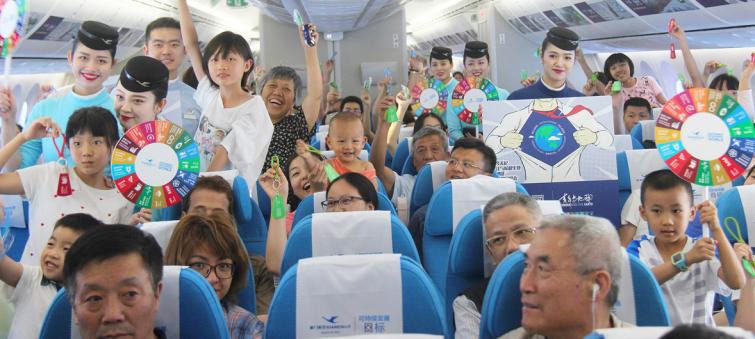
He also said that the airline has “the world’s only SDG livery airplane, called ‘United Dream’, with SDG “theme flights” that promote the Goals globally.
In closing, Zhao said that in the future, “we look forward to more efficient and cost-effective clean energy solutions that will lead the aviation industry to sustainable development”.
Xiamen Airlines
Support Our Journalism
We cannot do without you.. your contribution supports unbiased journalism
IBNS is not driven by any ism- not wokeism, not racism, not skewed secularism, not hyper right-wing or left liberal ideals, nor by any hardline religious beliefs or hyper nationalism. We want to serve you good old objective news, as they are. We do not judge or preach. We let people decide for themselves. We only try to present factual and well-sourced news.
Support objective journalism for a small contribution.


