


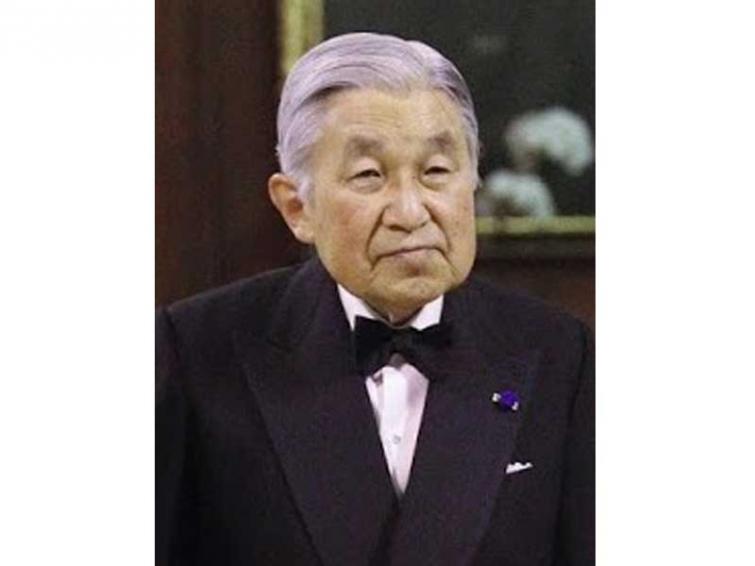
Emperor Akihito to abdicate throne on Tuesday
Tokyo, Apr 30 (Xinhua) Japan's Emperor Akihito will abdicate at the end of Tuesday marking the end of the three-decade long Heisei Era and the first time a monarch here has left the Chrysanthemum Throne within their lifetime in more than 200 years.
Akihito, 85, who performed his last rituals at the Imperial Palace earlier in the day, including reporting his abdication to his ancestors, will make his last speech to the public later in the day.
Prior to this, he will receive words of appreciation from Japanese Prime Minister Shinzo Abe, as representative of the general public.
Crown Prince Naruhito, 59, will accede to the throne on Wednesday.
Some members of the public gathered in front of the Imperial Palace to pay their respects, offer gratitude and messages of good will to the out going emperor.
They gathered despite the inclement weather, with many wishing to mark the last day of the Heisei Era under the current emperor, which will formally end at midnight when the emperor steps down.
Era names, or "gengo" as they are known in Japanese, are used in Japan for the length of a monarch's reign.
The new era name, Reiwa, meaning beautiful harmony, was announced by the government on April 1.
New era names are usually announced after the accession of the new monarch, but the government decided to announce the new name in advance of the accession of the new emperor.
This was so companies and the general public had time to prepare for the change and disruption would be kept to a minimum.
The Japanese premiere at the time said that the government wanted to select a name that conveys the heralding of a "new era full of hope."
Abe said the new era name was decided upon as it connotes "people's hearts coming together beautifully to nurture a culture."
"The name Reiwa means that culture is born and grows when people come together and care for each other beautifully," Abe said.
He also said he hoped the new era ahead would be one that held great promise for the younger generations.
"Heisei," the name of the current era, means "achieving peace" and began on Jan. 8, 1989, the day after Emperor Hirohito, the current emperor's father died.
Emperor Akihito was the first monarch enthroned under Japan's post-war Constitution that defines the role of the monarch as a merely a "symbol of the State."
Japan's 85-year-old emperor, Japan's 125th according to the traditional order of succession, expressed his desire to step down, however, in a rare video message broadcast in 2016.
During the video message he expressed his concern that owing to his age he might not be able to fulfill his official duties.
A year later, the parliament passed a one-off bill enabling him to do so. TOKYO, April 30 (Xinhua) -- Japan's Emperor Akihito will abdicate at the end of Tuesday marking the end of the three-decade long Heisei Era and the first time a monarch here has left the Chrysanthemum Throne within their lifetime in more than 200 years.
Akihito, 85, who performed his last rituals at the Imperial Palace earlier in the day, including reporting his abdication to his ancestors, will make his last speech to the public later in the day.
Prior to this, he will receive words of appreciation from Japanese Prime Minister Shinzo Abe, as representative of the general public.
Crown Prince Naruhito, 59, will accede to the throne on Wednesday.
Some members of the public gathered in front of the Imperial Palace to pay their respects, offer gratitude and messages of good will to the out going emperor.
They gathered despite the inclement weather, with many wishing to mark the last day of the Heisei Era under the current emperor, which will formally end at midnight when the emperor steps down.
Era names, or "gengo" as they are known in Japanese, are used in Japan for the length of a monarch's reign.
The new era name, Reiwa, meaning beautiful harmony, was announced by the government on April 1.
New era names are usually announced after the accession of the new monarch, but the government decided to announce the new name in advance of the accession of the new emperor.
This was so companies and the general public had time to prepare for the change and disruption would be kept to a minimum.
The Japanese premiere at the time said that the government wanted to select a name that conveys the heralding of a "new era full of hope."
Abe said the new era name was decided upon as it connotes "people's hearts coming together beautifully to nurture a culture."
"The name Reiwa means that culture is born and grows when people come together and care for each other beautifully," Abe said.
He also said he hoped the new era ahead would be one that held great promise for the younger generations.
"Heisei," the name of the current era, means "achieving peace" and began on Jan. 8, 1989, the day after Emperor Hirohito, the current emperor's father died.
Emperor Akihito was the first monarch enthroned under Japan's post-war Constitution that defines the role of the monarch as a merely a "symbol of the State."
Japan's 85-year-old emperor, Japan's 125th according to the traditional order of succession, expressed his desire to step down, however, in a rare video message broadcast in 2016.
During the video message he expressed his concern that owing to his age he might not be able to fulfill his official duties.
A year later, the parliament passed a one-off bill enabling him to do so.
Image: Wikimedia Commons
Support Our Journalism
We cannot do without you.. your contribution supports unbiased journalism
IBNS is not driven by any ism- not wokeism, not racism, not skewed secularism, not hyper right-wing or left liberal ideals, nor by any hardline religious beliefs or hyper nationalism. We want to serve you good old objective news, as they are. We do not judge or preach. We let people decide for themselves. We only try to present factual and well-sourced news.
Support objective journalism for a small contribution.


