


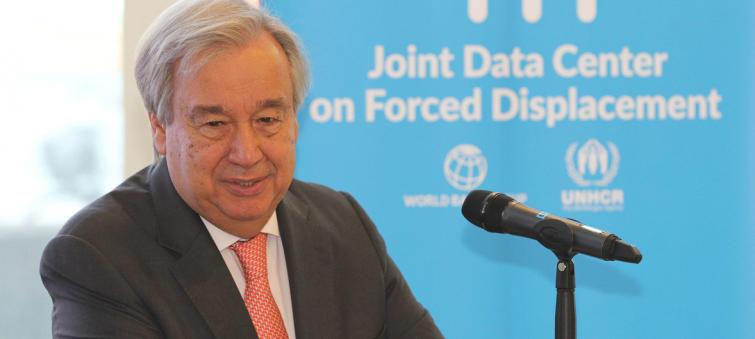
New refugee data centre can inform policies, solutions worldwide: Guterres
New York: A new UN refugee data centre will improve the way humanitarian agencies support “some of the most dramatically vulnerable people in the world”, UN chief António Guterres said on Thursday.
In Copenhagen, at the launch of the centre, Mr. Guterres said that many decisions are based on incorrect information, because key data needed to identify problems and solutions, does not exist.
However, by establishing centres of excellence, which effectively collect and use data, the UN system can rectify the problem, and help policy-makers find solutions to humanitarian crises.
The Joint Data Centre, a collaboration between the UN refugee agency, UNHCR, and the World Bank, aims to combine the former’s knowledge, and data, on refugees and displaced persons, with the latter’s global experience of poverty reduction, and socio-economic analytical experience.
The work of the Centre will support the objectives formulated in the Global Compact on Refugees, a UN document designed to strengthen the international response to large movements of refugees and protracted refugee situations.
The “micro data” that will be collected (such as income, consumption, skills, and health status) is in great demand, as knowledge of the welfare and poverty conditions of refugees is not widely known: access is often challenging, and sometimes risky.
With better micro data, the Centre will be able to conduct poverty assessments, skills or labour market analyses, or studies that follow people over time. Such studies will be critical for sound, evidence-based policies that concern refugees. To ensure privacy, this data will be anonymized, and sensitive individual protection-related data will not be included.
As well as gathering information on refugees, the Centre will collect data on the communities which host displaced persons. These communities are both positively and negatively impacted by the presence of refugees, and better data will enable support programs to be better designed.
Photo caption and credit:
Support Our Journalism
We cannot do without you.. your contribution supports unbiased journalism
IBNS is not driven by any ism- not wokeism, not racism, not skewed secularism, not hyper right-wing or left liberal ideals, nor by any hardline religious beliefs or hyper nationalism. We want to serve you good old objective news, as they are. We do not judge or preach. We let people decide for themselves. We only try to present factual and well-sourced news.
Support objective journalism for a small contribution.


