


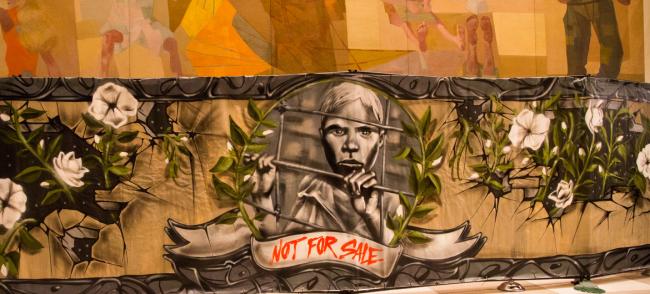
Over 40 million people still victims of slavery: ILO
New York, Dec 3 (IBNS): Slavery is still a very real and widespread phenomenon, affecting more than 40 million people worldwide, says the International Labour Organization (ILO), with children making up a quarter of the victims , despite the entry into force of the landmark Forced Labour protocol in 2016.
2 December is designated the UN International Day for the Abolition of Slavery, which marks the adoption by the General Assembly of the United Nations Convention for the Suppression of the Traffic in Persons and of the Exploitation of the Prostitution of Others, which entered into force in 1951.
The day is an opportunity to raise awareness of this global issue, and focus on the eradication of contemporary forms of slavery, such as human trafficking, sexual exploitation, the worst forms of child labour, forced marriage, and the forced recruitment of children for use in armed conflict.
Most child labour that occurs today is for economic exploitation, contrary to the Convention on the Rights of the Child, which recognizes “the right of the child to be protected from economic exploitation and from performing any work that is likely to be hazardous or to interfere with the child’s education, or to be harmful to the child’s health or physical, mental, spiritual, moral or social development.”
Human trafficking is also explicitly prohibited by the Protocol to Prevent, Suppress and Punish Trafficking in Persons Especially Women and Children, adopted by the General Assembly in 2000, which defines trafficking as the “recruitment, transportation, transfer, harbouring or receipt of persons, by means of the threat or use of force or other forms of coercion for the purpose of exploitation.”
The ILO leads an ongoing campaign, along with its partners, to convince 50 countries to ratify the legally-binding Forced Labour Protocol, called 50 for freedom, where members of the public are encouraged to add their names to help reach the target: to date 27 countries have ratified the protocol.
UN News/Daniela Gross
Support Our Journalism
We cannot do without you.. your contribution supports unbiased journalism
IBNS is not driven by any ism- not wokeism, not racism, not skewed secularism, not hyper right-wing or left liberal ideals, nor by any hardline religious beliefs or hyper nationalism. We want to serve you good old objective news, as they are. We do not judge or preach. We let people decide for themselves. We only try to present factual and well-sourced news.
Support objective journalism for a small contribution.


