


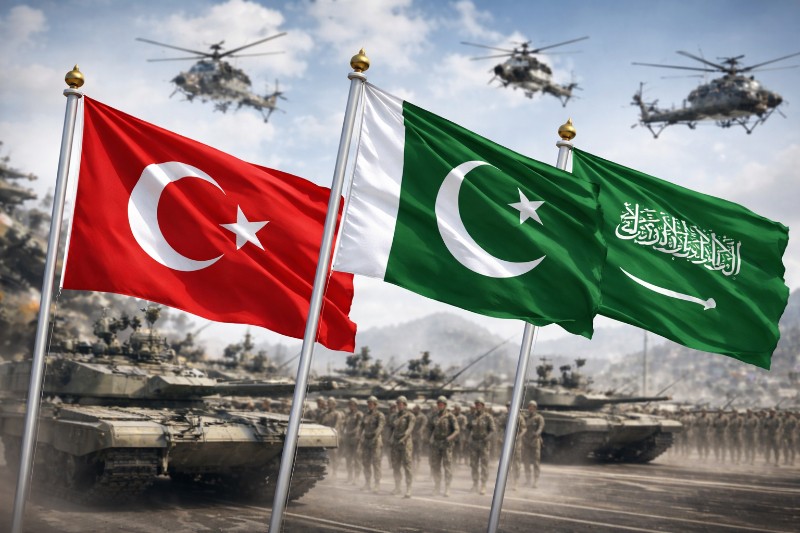
 Muslim NATO
Turkey eyes entry into Pakistan-Saudi defence bloc: Why India is watching this ‘Muslim NATO’ warily
Turkey is in advanced negotiations to join a defence partnership between Saudi Arabia and Pakistan, according to a Bloomberg report.
The move could significantly reshape security dynamics across West Asia and South Asia, with India emerging as one of the most affected regional stakeholders.
Sources familiar with the matter told Bloomberg that discussions have reached an advanced stage and a formal agreement may soon be announced.
If finalised, Ankara’s induction would elevate the pact from a bilateral understanding into a trilateral security framework.
Inside Pakistan-Saudi defence pact
Pakistan and Saudi Arabia signed a Strategic Mutual Defence Agreement in September 2025.
Though the full text remains classified, the pact reportedly includes a collective defence clause similar to NATO’s Article 5, under which an attack on one member would be treated as an attack on all.
Reports suggest the agreement allows Pakistan’s military capabilities, including its nuclear deterrent, to factor into Saudi Arabia’s defence planning if required.
The framework has been described by some observers as a potential “Muslim NATO,” aimed at creating a unified security front among Muslim-majority nations.
While the alliance currently remains largely symbolic, Saudi Arabia, the UAE and Egypt maintain close ties with India and are unlikely to allow Islamabad to dominate its agenda.
However, Pakistan’s active promotion of the bloc highlights its desire to position itself as a military leader within the Islamic world.
Why Turkey’s inclusion could change equation
Turkey’s entry would transform the arrangement into a three-nation security bloc combining distinct strengths: Saudi Arabia’s financial resources, Pakistan’s nuclear and missile capabilities, and Turkey’s combat experience and defence manufacturing expertise.
Nihat Ali Ozcan, a strategist at Ankara-based think tank TEPAV, told Bloomberg that the alignment brings together complementary capabilities, enhancing its potential regional influence.
Despite being a major NATO member with the alliance’s second-largest military, Ankara appears to be exploring parallel security frameworks amid uncertainty over Washington’s long-term global commitments.
“As the US increasingly prioritises its own strategic interests, regional actors are reassessing alliances and identifying new partners,” Ozcan noted.
Growing Turkey-Pakistan military ties
Turkey has consistently supported Pakistan on Kashmir and played a direct role in backing Islamabad during Operation Sindoor in May 2025, when India and Pakistan were locked in a brief military confrontation.
Reports indicate that Turkey supplied Pakistan with hundreds of drones, including Bayraktar TB2 and YIHA systems, along with trained personnel.
Defence cooperation has since expanded across multiple domains.
Turkey is assisting Pakistan in building Babur-class corvettes based on the MILGEM design and has already delivered warships such as PNS Babur and PNS Khaiber.
Turkish Aerospace Industries is also overseeing a major upgrade of 42 Pakistani F-16 fighter jets, extending their operational life.
Ahead of Operation Sindoor, Ankara dispatched a naval warship to Karachi and sent a C-130 military transport aircraft to Pakistan, though it later claimed the move was unrelated to the standoff.
Strategic concerns for India
Indian Air Force veteran Air Marshal Anil Chopra (Retd) has warned that Turkey’s potential entry into the pact could complicate India’s security environment.
Writing in The Eurasian Times, Chopra said the alliance could eventually threaten countries such as India, Israel, Armenia and Cyprus.
He stressed that the emerging Turkey-Pakistan axis must be assessed alongside India’s growing defence cooperation with Israel.
Chopra also pointed to India’s expanding strategic ties with Greece and Cyprus, suggesting a broader geopolitical counterbalancing may already be underway.
Beyond South Asia, analysts believe the trilateral bloc could alter power equations in regions where India has significant energy and trade interests, particularly West Asia.
A regional reset in the making?
Turkey’s interest in the pact is also linked to improving ties with Saudi Arabia.
The two nations have historically competed for leadership within the Sunni Muslim world, but recent years have seen a thaw, driven by shared concerns over Iran, Syria and Palestine.
If Turkey formally joins the alliance, it would mark a major diplomatic reset between Ankara and Riyadh.
Turkey’s Defence Ministry declined to comment on the talks, while Saudi and Pakistani officials have yet to issue formal statements.
What lies ahead
If finalised, the trilateral alliance is likely to draw close scrutiny from India, the United States, NATO and Iran.
Observers say it could reshape security dynamics across West and South Asia, creating new strategic alignments and rivalries.
For New Delhi, Turkey’s potential entry into the Pakistan-Saudi bloc adds another layer of complexity to an already volatile regional security landscape, ensuring that developments will be watched with growing caution.
Support Our Journalism
We cannot do without you.. your contribution supports unbiased journalism
IBNS is not driven by any ism- not wokeism, not racism, not skewed secularism, not hyper right-wing or left liberal ideals, nor by any hardline religious beliefs or hyper nationalism. We want to serve you good old objective news, as they are. We do not judge or preach. We let people decide for themselves. We only try to present factual and well-sourced news.
Support objective journalism for a small contribution.


