


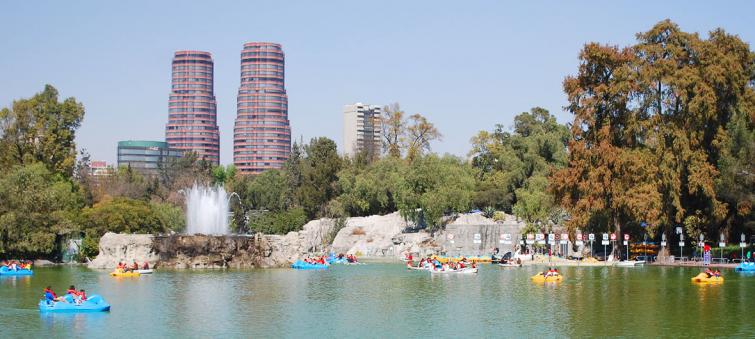
Turning waste into wealth: World Habitat Day focus on cleaning up cities
New York: Waste can have a devastating effect on public health, the environment, and the climate, but cutting-edge innovation and technology can provide improved, cheaper solutions to the challenge, and help cities and communities to see waste as a business opportunity. This was the message marking World Habitat Day, on Monday, with a focus on waste management.
"We must reduce the amount of waste we produce", said UN Secretary-General António Guterres in a statement. "And, at the same time, start seeing it as a valuable resource that can be re-used and recycled, including for energy".
Linked to the International Day, UN-Habitat, the United Nations agency for human settlements, has launched a "Waste Wise Cities" campaign, to address the increasing challenges of coping with solid waste.
As part of the campaign, cities are invited to confirm their commitment to uphold a set of principles. These include assessing the quantity and type of waste, improving waste collection, ensuring cities are environmentally safe, and implementing waste-to-energy schemes.
The campaign notes that dealing with waste eats up a significant proportion of city budgets, and that waste management is not being sufficiently financed. So-called "frontier technologies", however, can provide cost-effective answers to the problem of how to clean up cities.
Examples include automation and artificial intelligence which, when used together, can help sort recyclables more efficiently. Smart packaging is another potential solution, using sensors to help reduce the amount of food thrown away, and innovative new technologies which can turn organic waste into renewable energy and compost.
The technology also provides an opportunity for newer, rapidly-growing cities in developing countries to "leapfrog" older cities, by taking advantage of the latest solutions and avoiding more established, but less efficient methods.
Using these tools effectively, said the UN chief on Monday, can help us to build well-planned and smartly managed cities, which can steer us towards inclusive growth, and low-emission development.
The potential benefits of frontier technologies for developing countries are outlined in the UN’s 2018 World Economic and Social Survey, which concludes that they can help the world to change for the better, and achieve the Sustainable Development Goals (SDGs), and address climate change.
The study also warns that the widespread introduction of these tools must be accompanied by appropriate, effective policies, to help countries to avoid pitfalls and minimize the economic and social costs of technology-related disruption.
Support Our Journalism
We cannot do without you.. your contribution supports unbiased journalism
IBNS is not driven by any ism- not wokeism, not racism, not skewed secularism, not hyper right-wing or left liberal ideals, nor by any hardline religious beliefs or hyper nationalism. We want to serve you good old objective news, as they are. We do not judge or preach. We let people decide for themselves. We only try to present factual and well-sourced news.
Support objective journalism for a small contribution.


