


UN chief urges scaled up response for peace, across troubled Sahel’s region
New York: Humanitarian and development responses for Mali and Africa’s wider Sahel region “are falling short”, and support must be scaled up to ensure a hopeful future for its people, the Secretary-General told world leaders at a special high level meeting inside UN Headquarters on Wednesday.
“The time has come for the urgent mobilization to support countries and people of the Sahel,” UN chief António Guterres said on the margins of the UN’s 74th General Assembly.
The meeting hosted a discussion around the implementation of priority measures, and recent operations to strengthen international and regional support, such as the Security Council’s renewed mandate for Mali’s UN peacekeeping mission (MINUSMA) to promote peace and security there.
Since 2012, Mali and the wider Sahel region has seen instability wrought by political turmoil, growing violent extremism, widespread poverty, unemployment, economic disparities, crumbling governance and lack of access to basic services.
Environmental issues, shrinking natural resources, climate change and population growth, have further exacerbated the problem, fueling tensions between communities, and incentivizing extremist groups to spread militant ideologies across the region.
The time has come for the urgent mobilization to support countries and people of the Sahel--António Guterres
Partners should “ensure prompt disbursement of the funds committed and to support the implementation of the UN’s Integrated Strategy for the Sahel”, the UN chief urged. The 2013 plan, endorsed by the Security Council, prioritizes life-saving activities to meet immediate needs, and provides a framework for resilience-building.
In addition, the Joint Force of the G-5 Sahel, “remains critical in fighting extremist and armed groups,'' Mr. Guterres said, referring to the coalition of five African countries (Burkina Faso, Chad, Mali, Mauritania and Niger) united to combat the Sahel’s complex web of criminal networks and extremist militias.
“A significant portion” of the $2.3 billion to prioritize G-5 operations, pledged at a donor conference last December, “has not yet been disbursed”, and “this year, just one fifth of the necessary humanitarian funds have been received so far,” Mr. Guterres lamented.
Funding shortfalls coupled with dire humanitarian need, outpacing available resources, means some 5.1 million of the region’s people will need assistance in 2019 alone, the UN humanitarian affairs coordination office (OCHA) estimates.
A disrupted peace process and lawlessness in the northern and central regions, has left more than 100,000 people displaced within Mali, 220,000 in Burkina Faso, and 400,000 in Niger - a transnational crisis which the UN chief described as “a regional threat”.
“Stemming and preventing escalation requires offering people, and particularly young people, a hopeful future”, Mr. Guterres said in closing.
What youth and adults alike need, is “a perspective that goes beyond their daily needs”, he said, “to ensure development, promote gender equality, and ensure access to economic opportunities and social services.”
Photo Caption and Credit:
MINUSMA/Gema Cortes
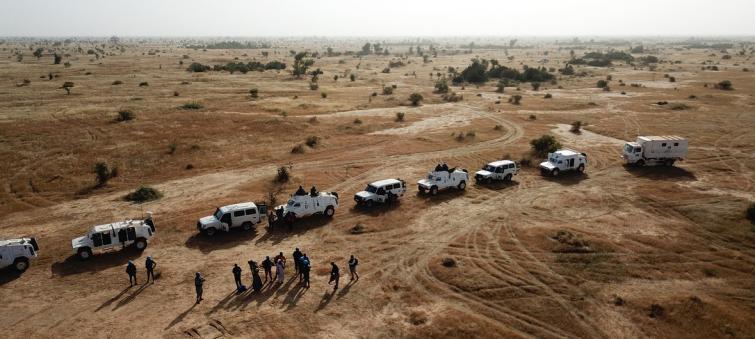
Senegalese peacekeepers from the UN peacekeeping mission, MINUSMA, patrol Koro, in Mali’s central Mopti region. (December 2018)
Support Our Journalism
We cannot do without you.. your contribution supports unbiased journalism
IBNS is not driven by any ism- not wokeism, not racism, not skewed secularism, not hyper right-wing or left liberal ideals, nor by any hardline religious beliefs or hyper nationalism. We want to serve you good old objective news, as they are. We do not judge or preach. We let people decide for themselves. We only try to present factual and well-sourced news.
Support objective journalism for a small contribution.


