


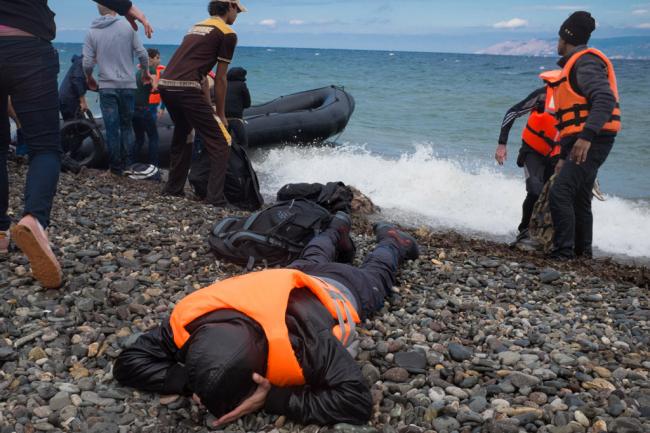
UN official urges global compact on refugee and asylum matters
Speaking in Geneva at the UNHCR annual Executive Commitment meeting, Volker Türk, UNHCR’s Assistant High Commissioner for Protection, drew attention to the 60 million forcibly displaced people living in a troubled global landscape of increased conflict, coupled with an ever-more dire humanitarian funding situation.
He also noted that some countries are building fences or walls to keep refugees out, or using deterrence to shift people onto the territories of their neighbours, as well as denying school for children and legal work for adults.
“Push-backs, building walls, increasing detention, and further restricting access, combined with few legal avenues to safety, will never be the answer,” said Mr. Türk.
“The impact is simply the diversion of refugee movements along other routes and the aggravation of already precarious situations in regions embroiled in conflict,” he continued. “Worse still, these measures compel more people who have nothing left to lose to risk dangerous journeys onward in the hope of finding eventual safety and stability.”
Türk also warned against an apparent lack of responsibility for the safety of refugees.
“It is also becoming increasingly evident that the single most important challenge to the safety and protection of refugees arises from populist politics and toxic public debates, as well as the climate of fear they engender,” he said.
“This is often fuelled and abetted by irresponsible media reporting, lack of political and moral leadership, and xenophobia and racism,” he continued. “In some countries around the world, there has been a proliferation of xenophobic narratives, hate speech, fear-mongering, and inflammatory statements – both at the political and civil society levels.”
Türk also noted the need to build closer ties between displaced people and the communities that host them, which, if left unsupported, could easily become overwhelmed.
“Community-based protection includes investment in national and community capacity to reinforce social cohesion between the displaced – be they refugees or IDPs [internally displaced persons] – and their host communities. This helps to preserve pluralism and diversity as well as promote peaceful co-existence,” he said.
In his concluding remarks, he said that an all-out effort was needed “to ensure that protection, and in particular the institution of asylum remains life-saving, non-political, and fundamentally humanitarian.”
“We must call upon our shared humanity, histories and sacred traditions of providing refuge to persons fleeing conflict and persecution, and remember that it was exactly for times like these that the international refugee protection regime was created,” said Türk.
He also added that the 1951 Refugee Convention recognized that the problems of forced displacement cannot be achieved by countries working in isolation.
“This speaks to the most critical protection gap we are facing today – the need for a global compact on predictable and equitable burden and responsibility-sharing,” he said.
He added, “In a world in turmoil, we need a sense of equanimity, purpose, and trust to make such a compact a reality.”
Photo: UNICEF/Ashley Gilbertson
Support Our Journalism
We cannot do without you.. your contribution supports unbiased journalism
IBNS is not driven by any ism- not wokeism, not racism, not skewed secularism, not hyper right-wing or left liberal ideals, nor by any hardline religious beliefs or hyper nationalism. We want to serve you good old objective news, as they are. We do not judge or preach. We let people decide for themselves. We only try to present factual and well-sourced news.
Support objective journalism for a small contribution.


