


 UNSC
UNSC
UN Security Council to welcome five new non-permanent members
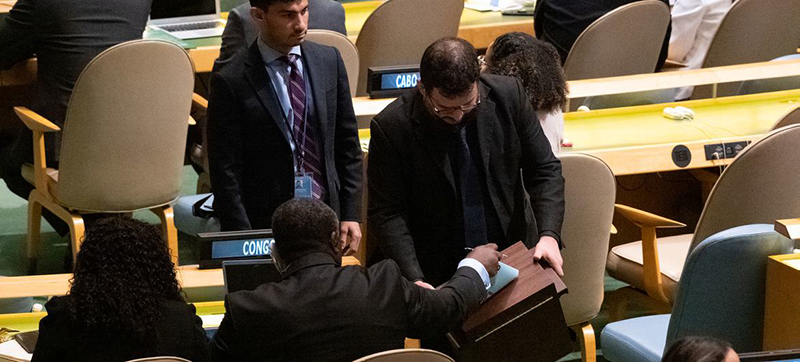
New York: Five countries have been elected as non-permanent members of the UN Security Council following a vote in the General Assembly on Tuesday.
Algeria, Guyana, Republic of Korea, Sierra Leone and Slovenia will join the premier body for maintaining international peace and security, starting in January, serving for a two-year period.
They were among six countries vying for five non-permanent seats around the Council’s horseshoe-shaped table that will become vacant at the end of the year.
Securing a seat
The Security Council is composed of 15 countries, five of which - China, France, Russia, the United Kingdom and the United States – are permanent members, granting them the right to veto any resolution or decision.
The 10 non-permanent members are elected by the General Assembly, which comprises all 193 UN Member States, and in line with geographical distribution by region.
Voting is conducted by secret ballot and candidates must receive a two-thirds majority, or 128 votes, even if they run uncontested.
Overall, 192 countries voted to fill three Council seats allocated to the Africa and Asia-Pacific Groups, and one each for Eastern Europe and Latin America and the Caribbean.
Slovenia beat Belarus in the race for Eastern Europe, receiving 153 votes versus 38, while Algeria, Guyana, Sierra Leone and the Republic of Korea ran unopposed.
Ready to serve
The five newly elected countries will join Ecuador, Japan, Malta, Mozambique and Switzerland as non-permanent members of the Council.
They will take up seats currently occupied by Albania, Brazil, Gabon, Ghana and the United Arab Emirates when their two-year terms end on 31 December.
Support Our Journalism
We cannot do without you.. your contribution supports unbiased journalism
IBNS is not driven by any ism- not wokeism, not racism, not skewed secularism, not hyper right-wing or left liberal ideals, nor by any hardline religious beliefs or hyper nationalism. We want to serve you good old objective news, as they are. We do not judge or preach. We let people decide for themselves. We only try to present factual and well-sourced news.
Support objective journalism for a small contribution.


