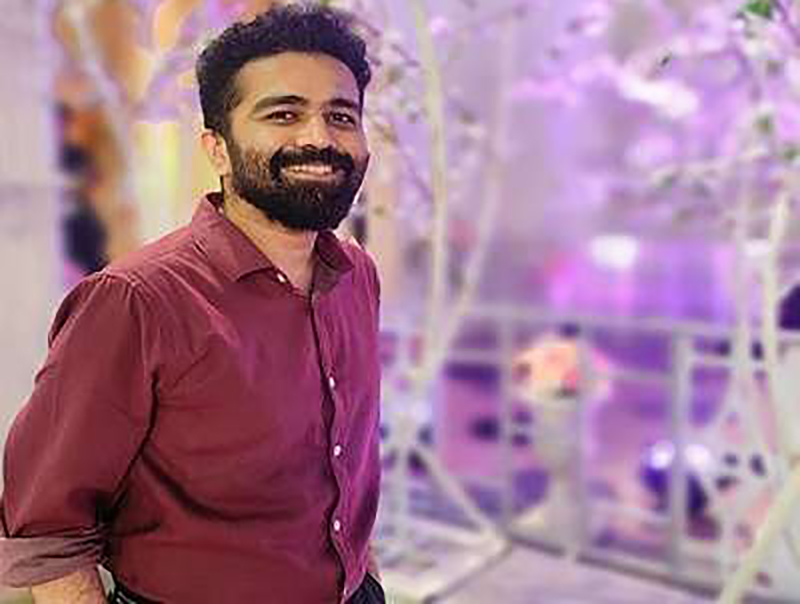
 Rishi Rajpopat
Indian PhD student at Cambridge solves 2500-year-old Sanskrit puzzle
New Delhi/ IBNS: An Indian PhD student at the University of Cambridge has finally solved a Sanskrit grammatical problem that has left scholars since the 5th century BC baffled.
A 27-year-old student-Rishi Atul Rajpopat-reportedly decoded a text written by the Sanskrit language master Panini.
Panini was a master of the ancient Sanskrit language who lived around two-and-a-half-thousand years ago, according to a report by BBC.
Rajpopat, is a PhD student at the faculty of Asian and Middle Eastern Studies at St. John's College, Cambridge.
According to the Independent, Panini taught a "metarule" which is traditionally interpreted by scholars as meaning: "in the event of a conflict between two rules of equal strength, the rule that comes later in the grammar's serial order wins".
However, this often led to grammatically incorrect results.
Rajpopat rejected this traditional interpretation of the metarule with the argument that Panini meant that between rules applicable to the left and right sides of a word respectively, Panini wanted us to choose the rule applicable to the right side.
He concluded that Panini's "language machine" produced grammatically correct words with almost no exceptions.
"I had a eureka moment in Cambridge. After nine months of trying to crack this problem, I was almost ready to quit, I was getting nowhere. So I closed the books for a month and just enjoyed the summer, swimming, cycling, cooking, praying, and meditating. Then, begrudgingly I went back to work, and, within minutes, as I turned the pages, these patterns started emerging, and it all started to make sense," he told the Independent.
It took him another two years to solve the problem.
Support Our Journalism
We cannot do without you.. your contribution supports unbiased journalism
IBNS is not driven by any ism- not wokeism, not racism, not skewed secularism, not hyper right-wing or left liberal ideals, nor by any hardline religious beliefs or hyper nationalism. We want to serve you good old objective news, as they are. We do not judge or preach. We let people decide for themselves. We only try to present factual and well-sourced news.
Support objective journalism for a small contribution.