


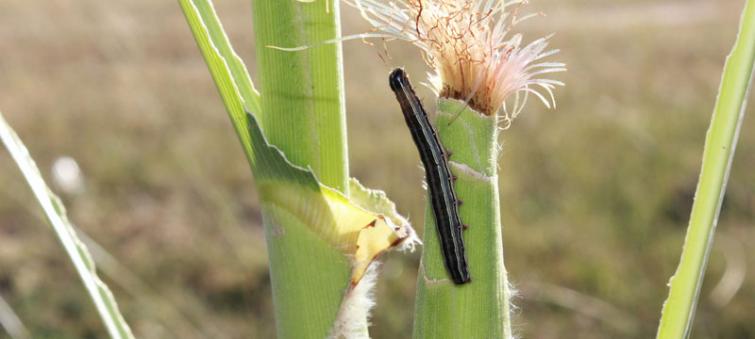
‘Growing alarm’ over Fall Armyworm advance, with cash crops ‘under attack’ across Asia
New York, Mar 21 (IBNS): The Fall Armyworm pest is continuing to sweep across the globe, having moved eastwards from their native Americas, onto Africa, before arriving in Asia only last summer, where they now threaten to cost farmers from India to Thailand, billions of dollars in lost production.
The UN Food and Agriculture Organization (FAO) has convened a three-day meeting of international experts in Bangkok and officials from affected countries, who on Wednesday began discussing what to do about stopping the onward march of the crop-guzzling insects, and limiting the devastation they cause.
"We are here today – together – because we share a growing sense of alarm – but also to learn from each other, particularly from those countries who’ve already been responding to their own infestations, said Kundhavi Kadiresan, Assistant Director-General and FAO Regional Representative for Asia and the Pacific.
Fall Armyworm is ‘here to stay’ “We need to work together because this is a pest that has no respect for international boundaries, threatens our food security, our economies, domestic and international trade, and of course the smallholder farmer who wakes up one morning to a cash crop under attack.”
Fall armyworm have been moving steadily east since 2016 and caused up to $3 billion-worth of damage to crops across Africa, according to reports. They lay eggs which develop fast into grubs, which can devastate crops such as maize, rice and sugarcane, overnight.
India began to suffer the effects of the flying invaders in July, and the insects have now reached Sri Lanka, Bangladesh, Myanmar, Thailand, and China’s Yunnan province, said FAO.
In the case of Sri Lanka, there were reports that up to 40,000 hectares had been infested, damaging some 20 percent of its crops. China is the biggest maize producer in Asia, and second largest producer globally.
“When Fall Armyworm made landfall in India, its arrival did not come as a complete surprise, we were not caught unaware. And that’s a good start – indeed it was a good head start,” Mr. Kadiresan said.
The Plant Protection Commission for Asia and the Pacific began raising awareness about the threat early last year, sharing key information on the pest, its spread towards Asia, and how to manage it sustainably in case of infestation.
Slowing the spread
Once an infestation is confirmed, governments are initiating efforts to continue to raise awareness and monitor the presence and spread of FAW on maize and other crops.
FAO has been working with the relevant authorities to initiate awareness programmes that inform and train farmers on integrated pest management techniques. These include identifying natural enemies of the Fall Armyworm, enhancing natural biological controls and mechanical controls, such as crushing egg masses and employing the use of biopesticides.
The use of chemical pesticides needs to be very carefully considered, given that FAW larvae hide largely in the ring of leaves (whorl), and that chemical pesticides can have negative effects on environment and public health. This is taken into consideration at policy and field level. With these measures put in place, the negative effects of infestations can be sustainably managed and can help to maintain populations low enough to limit economic and livelihood damage.
Image Credit: FAO/Lesotho/Lechoko Noko
Support Our Journalism
We cannot do without you.. your contribution supports unbiased journalism
IBNS is not driven by any ism- not wokeism, not racism, not skewed secularism, not hyper right-wing or left liberal ideals, nor by any hardline religious beliefs or hyper nationalism. We want to serve you good old objective news, as they are. We do not judge or preach. We let people decide for themselves. We only try to present factual and well-sourced news.
Support objective journalism for a small contribution.


