


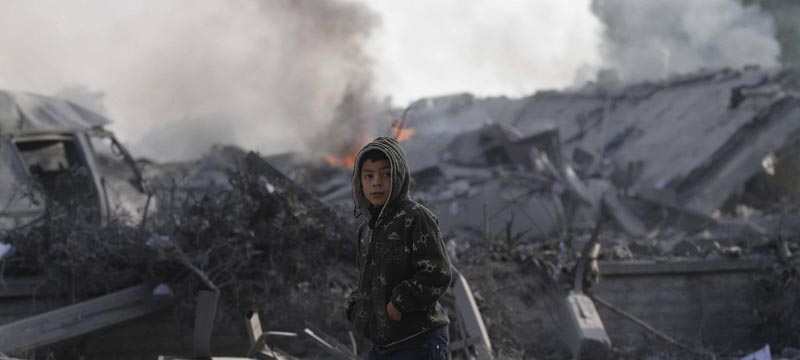
How a single Israeli strike on a Gaza IVF centre took away 5,000 lives: Report
Gaza: An Israeli air strike on Gaza's largest fertility clinic last December dealt a massive blow to the hopes of infertile couples as the explosion resulted in the destruction of over 4,000 embryos along with 1,000 specimens of sperm and unfertilized eggs, reported Reuters.
The explosion caused the lids to fly off five liquid nitrogen tanks storing the embryos and specimens of sperms situated in a corner of the embryology unit of Gaza City's Al Basma IVF center.
According to the report, this single explosion had widespread consequences, revealing the hidden impact of Israel's six-and-a-half-month assault on Gaza's 2.3 million residents.
The embryos stored in those tanks were the last chance for numerous Palestinian couples grappling with infertility.
"We know deeply what these 5,000 lives, or potential lives, meant for the parents, either for the future or for the past," Cambridge-trained obstetrician and gynaecologist Bahaeldeen Ghalayini was quoted as saying by Reuters.
The 73-year-old doctor established the clinic in 1997.
In the enclave, large families are common, with nearly half of the population being under 18, and the fertility rate stands high at 3.38 births per woman, as reported by the Palestinian Bureau of Statistics, the report said.
In comparison, Britain's fertility rate is much lower at 1.63 births per woman.
Even amidst Gaza's economic challenges, couples dealing with infertility still go for IVF. Some resort to selling their possessions, such as televisions and jewelry, to cover the costs, Al Ghalayini told Reuters.
At least nine clinics in Gaza offered IVF service, a process that involves extracting eggs from a woman's ovaries and subsequent fertilization with sperm in a laboratory setting.
The fertilized eggs, known as embryos, are typically preserved through freezing until the most suitable time for transfer into a woman's uterus.
The majority of frozen embryos in Gaza were stored at the Al Basma center.
As the Israeli attacks increased, Mohammed Ajjour, the chief embryologist at Al Basma, became increasingly concerned about the levels of liquid nitrogen in the five specimen tanks.
Regular top-ups were necessary nearly every month to maintain the temperature below -180°C in each tank, which operated independently of electricity.
When the war escalated, Ajjour managed to secure one delivery of liquid nitrogen. However, with Israel cutting off electricity and fuel supplies to Gaza, most suppliers ceased operations.
By the end of October, Israeli tanks rolled into Gaza, and soldiers closed in on the streets surrounding the IVF center. It became too perilous for Ajjour to access the tanks for maintenance checks.
Just a single Israeli shell hit the corner of the center, causing an explosion that destroyed the ground floor embryology lab, Ghalayini told Reuters.
He is, however, unsure whether the attack was specifically aimed at the lab or not.
“All these lives were killed or taken away: 5,000 lives in one shell," he told Reuters.
Now, in April, the embryology lab remains littered with shattered masonry, destroyed lab equipment, and amidst the debris, the liquid nitrogen tanks, reported a Reuters journalist who visited the site.
The tank lids were left ajar, and in one of the tanks, a basket filled with tiny color-coded straws containing the destroyed microscopic embryos could still be seen at the bottom, the report said.
Support Our Journalism
We cannot do without you.. your contribution supports unbiased journalism
IBNS is not driven by any ism- not wokeism, not racism, not skewed secularism, not hyper right-wing or left liberal ideals, nor by any hardline religious beliefs or hyper nationalism. We want to serve you good old objective news, as they are. We do not judge or preach. We let people decide for themselves. We only try to present factual and well-sourced news.
Support objective journalism for a small contribution.


