 West Bengal
Bengal activist mocked a traffic slogan, now faces charges of 'endangering sovereignty'
Kolkata/IBNS: The arrest of a West Bengal-based social activist over a sarcastic social media post has reignited concerns about state overreach and the growing use of stringent criminal provisions to police online speech.
Human rights groups have warned that a new law, widely viewed as a successor to the colonial-era sedition provision, is increasingly being deployed against criticism and satire.
Arrest over a satirical traffic message
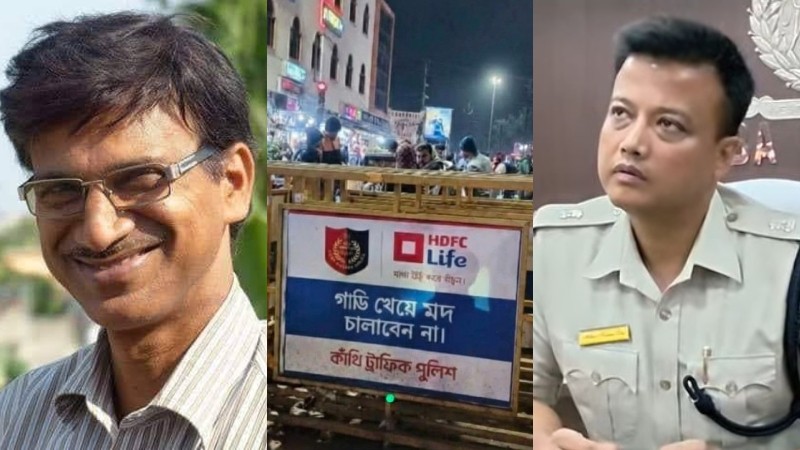
Amit Nandi, a social activist from Chinsurah in Hooghly district, was arrested by the West Bengal Police on February 14.
The arrest followed a first information report linked to a Facebook post in which Nandi mocked a traffic awareness slogan displayed at a traffic post under the Kanthi police station in East Medinipur district.
The post, made on January 27 and later deleted, played on the police slogan “mod kheye gari chalaben na” (don’t drive after drinking alcohol), altering it sarcastically to “gari kheye mod chalabben na” (don’t drink cars and drive alcohol).
Police described the post as a distortion of an official public-awareness message.
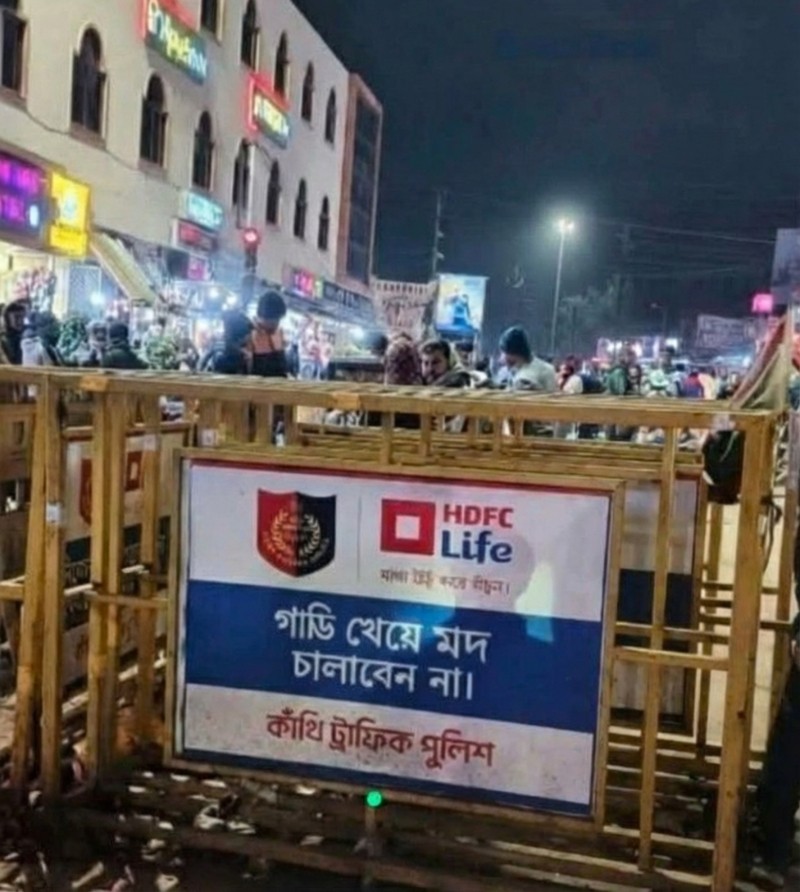 The social media post that led to the arrest of activist Amit Nandi. Photo: Facebook
FIR and serious criminal charges
A suo motu FIR was filed a day later by Sub-Inspector Dilip Gupta, who oversees social media monitoring at Kanthi police station.
According to the complaint, the post allegedly formed part of a “planned smear campaign” against the police and was widely shared due to Nandi’s online following.
Nandi has been booked under multiple sections of the Bharatiya Nyaya Sanhita (BNS), including Section 152, which deals with acts alleged to endanger India’s sovereignty, unity and integrity.
This provision has effectively replaced the repealed sedition law under the Indian Penal Code (IPC).
The charge carries a maximum punishment of life imprisonment or up to seven years in jail with a fine, and is both cognisable and non-bailable.
Additional charges include criminal intimidation and defamation, with the FIR claiming the post was intended to damage the dignity, reputation and public image of the police, while undermining public confidence in law enforcement.
What police say
East Medinipur Superintendent of Police Mitun Kumar Dey said the police had taken serious note of a social media post that initially appeared humorous but went far beyond satire.
"It has recently come to our attention that a post has been made that may seem a bit funny at first glance, and it is being widely ridiculed. The matter is not that simple because it undermines the mutual trust and respect that should exist between citizens and the police, and demeans and degrades this profession," the official said.
"Our cyber crime police station has registered a suo motu case. We have arrested a person named Amit Mondal. The investigation into the case is underway, and it is being led by the Inspector-in-Charge (IC) of the cyber crime PS. We have got a three-day remand of Amit Mondal," the SP added.
Dey also appealed to people not to share or circulate content that unnecessarily demeans any community or profession, warning that such actions could invite legal consequences.
"We will request people not to share such posts, which unnecessarily demean a community or a profession," he said.
Unequal enforcement raises questions
Notably, a woman content creator who allegedly shared the same post and was named in the FIR has not been arrested.
None of the "accused" currently has the post visible on their Facebook timelines, adding to questions about selective enforcement.
Nandi is known for promoting scientific temper and has frequently criticised the ruling Trinamool Congress, the Bharatiya Janata Party, and even the Left.
In recent weeks, he had posted critically about the Kolkata warehouse fire that killed 21 people and the arrest of another activist involved in facilitating cornea donation, drawing attention to state actions.
Rights groups warn of criminalising dissent
Human rights organisations have strongly criticised the arrest, describing it as part of a broader pattern where dissent is treated as a law-and-order issue.
The Association for Protection of Democratic Rights (APDR) argued that the use of Section 152 reflects a worrying convergence between BJP-ruled states and West Bengal in policing online speech.
APDR state secretary Rajit Sur alleged that social media surveillance has intensified in the state, claiming that accounts critical of the special intensive revision of voter rolls have been shut down.
He further stated that his own Facebook account was suspended following directions from state law enforcement.
Echoes of past free speech controversies
For many in West Bengal, the episode has revived memories of the 2012 arrest of Ambikesh Mahapatra, a Jadavpur University professor detained for circulating a satirical cartoon targeting Chief Minister Mamata Banerjee.
That case became emblematic of how criminal law can be weaponised against speech, before Mahapatra was eventually acquitted in 2023 after a decade-long legal battle.
Mahapatra has since said that the police routinely disregard constitutional safeguards and judicial precedents, warning that freedom of expression remains fragile in the state.
Supreme Court’s call for restraint
The arrest comes despite recent judicial caution on criminal cases linked to online expression.
In February 2026, the Supreme Court of India upheld a Telangana High Court order mandating safeguards against arbitrary arrests over social media criticism, including prior inquiry and verification of complaints.
Legal observers note that Amit Nandi’s case will test whether such principles are being followed in practice.
Nandi is scheduled to be produced in a local court again on February 23.
Support Our Journalism
We cannot do without you.. your contribution supports unbiased journalism
IBNS is not driven by any ism- not wokeism, not racism, not skewed secularism, not hyper right-wing or left liberal ideals, nor by any hardline religious beliefs or hyper nationalism. We want to serve you good old objective news, as they are. We do not judge or preach. We let people decide for themselves. We only try to present factual and well-sourced news.
Support objective journalism for a small contribution.