'If passport isn't proof of citizenship, then what is?' Shashi Tharoor questions Centre, suggests Aadhaar overhaul
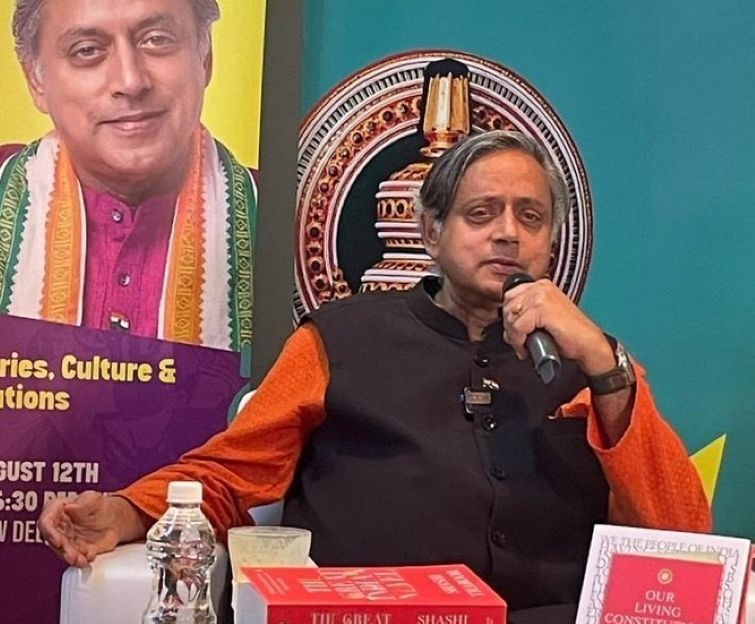
Congress MP Shashi Tharoor has questioned the Centre's assertion that an Indian passport is not conclusive proof of citizenship, calling the government's position a "legal paradox" that has left the public confused.
Reacting to the Ministry of External Affairs' clarification that a passport is primarily a travel document and not definitive evidence of citizenship, Tharoor said the distinction may be legally valid but is incomprehensible to ordinary citizens.
"For decades, the passport has been regarded as the gold standard of identity. Citizens undergo extensive police verification and document scrutiny precisely because the state demands proof of citizenship before issuing one. To now say that this document does not establish citizenship creates an absurd legal paradox. If a passport does not prove citizenship, then what does?" Tharoor wrote in a post on X.
The recent statement by the Ministry of External Affairs (MEA) - - on #PassportSevaDivas, no less! - - clarifying that an Indian passport is primarily a "travel document and not conclusive proof of citizenship" has triggered a predictable wave of public bewilderment and…
— Shashi Tharoor (@ShashiTharoor) June 26, 2026
Government cites Passports Act
The clarification has sparked political debate after the MEA reiterated that its position is rooted in Section 20 of the Passports Act, 1967, which allows the government, under exceptional circumstances and in the public interest, to issue passports or travel documents to non-citizens.
Government sources stressed that this is not a new interpretation.
"It was not decided yesterday, nor during the last 12 years under the Narendra Modi government. A passport has never been legal proof of citizenship," a government source said.
Tharoor proposes legislative changes
To end the controversy, Tharoor urged the government to amend the legal framework so that both passports and Aadhaar cards become conclusive proof of Indian citizenship unless cancelled or revoked by the state.
He acknowledged, however, that Aadhaar currently serves as proof of residence rather than nationality, making it available to both citizens and eligible non-citizen residents.
As a solution, Tharoor proposed that the Unique Identification Authority of India (UIDAI) issue a visually distinct Aadhaar card for non-citizens, suggesting a design featuring a visible diagonal red stripe.
According to him, such a distinction would allow the government to treat a standard Aadhaar card or a valid Indian passport as sufficient proof of citizenship, reducing bureaucratic hurdles and eliminating confusion during processes such as electoral roll revisions.
"This dual-document policy would streamline domestic verification, reduce arbitrary bureaucratic challenges and provide every Indian with clear legal certainty regarding their identity," he argued.
Passport fees revised
Meanwhile, amid the ongoing debate, the Ministry of External Affairs on Thursday published a gazette notification dated June 20 announcing a revision in passport fees.
The application fee for a fresh ordinary 36-page passport has been increased from Rs 1,500 to Rs 2,500.
Support Our Journalism
We cannot do without you.. your contribution supports unbiased journalism
IBNS is not driven by any ism- not wokeism, not racism, not skewed secularism, not hyper right-wing or left liberal ideals, nor by any hardline religious beliefs or hyper nationalism. We want to serve you good old objective news, as they are. We do not judge or preach. We let people decide for themselves. We only try to present factual and well-sourced news.
Support objective journalism for a small contribution.