 Strait of Hormuz
Middle East conflict: Four fertiliser ships brave Strait of Hormuz chaos to secure India’s agri supply
Four Indian cargo vessels carrying essential shipments of urea, di-ammonium phosphate (DAP), and sulphur have successfully transited the Strait of Hormuz last week, despite heightened geopolitical tensions in the region amid the ongoing Iran-US conflict.
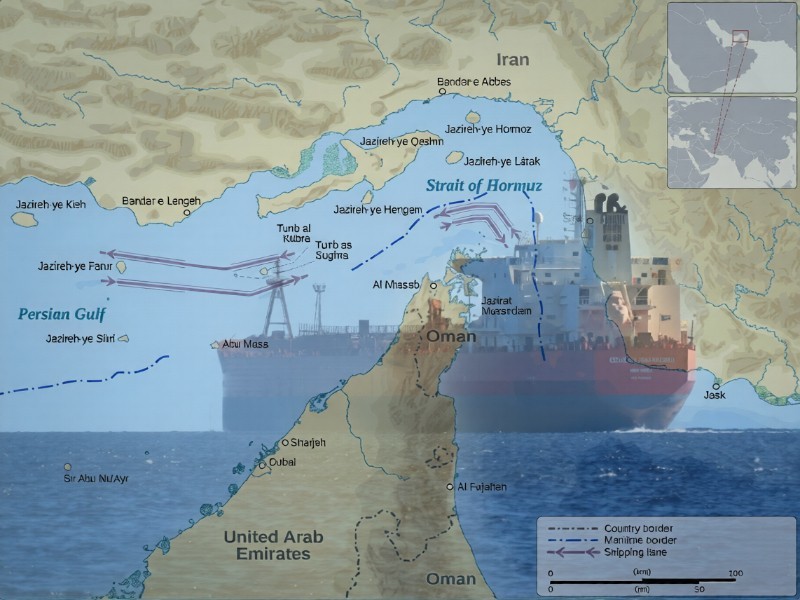
The Strait of Hormuz, a strategically vital maritime chokepoint, connects the Persian Gulf with the Gulf of Oman and the wider Arabian Sea. It serves as a key transit route for global energy exports from major producers including Saudi Arabia, Iraq, Kuwait and the United Arab Emirates.
According to an official statement, the vessels are now en route to their respective destination ports in India—Krishnapatnam, Kakinada, Paradeep and Mundra.
“Navigating through ongoing global trade challenges, these vessels are currently heading toward their designated destination ports across the country,” the statement said.
Upon arrival, the shipments will be immediately offloaded to strengthen India’s fertilizer reserves and support ongoing agricultural requirements.
Strong Inventory Position
India’s total fertilizer stock position as of June 22, 2026, stands at 196.08 lakh tonnes, significantly higher than 168.67 lakh tonnes recorded during the same period last year.
The current inventory includes:
Urea: 81.44 lakh tonnes (69.21 lakh tonnes last year)
DAP: 20.92 lakh tonnes (16.00 lakh tonnes last year)
NPKs: 55.91 lakh tonnes (46.13 lakh tonnes last year)
MOP: 12.68 lakh tonnes (10.68 lakh tonnes last year)
SSP: 25.13 lakh tonnes (26.65 lakh tonnes last year)
Rising Fertiliser Demand and Sales
Reflecting strong agricultural activity, total fertiliser sales from March 1 to June 21, 2026, stood at 153.4 lakh tonnes, an increase of 13.2 lakh tonnes compared to 140.2 lakh tonnes during the same period last year.
This includes 79.1 lakh tonnes of urea, 34.8 lakh tonnes of NPKs, and 19.8 lakh tonnes of DAP (including TSP).
Domestic Production and Imports Strengthened
To safeguard farmers against global supply disruptions, domestic fertiliser production has been scaled up significantly, reaching 133.12 lakh tonnes. This has been complemented by imports totaling 43.69 lakh tonnes during the same period, ensuring a balanced supply chain.
Global Procurement Strategy
India has contracted 17.70 lakh tonnes of urea in the latest global tender, taking total secured imports of urea and P&K fertilisers to over 90 lakh tonnes for the ongoing Kharif season.
Procurement has been supported through coordinated diplomatic engagement across 28 Indian missions abroad, enabling diversified sourcing routes.
Urea imports have been secured from countries including Oman, Malaysia, Vietnam, Georgia, Nigeria, Russia, Finland, Egypt, Algeria, Turkey and the Netherlands.
DAP and NPK supplies have been arranged via multiple global corridors, including Russia, Morocco, Egypt, the United States, Jordan, South Korea, Tunisia and Saudi Arabia.
Support Our Journalism
We cannot do without you.. your contribution supports unbiased journalism
IBNS is not driven by any ism- not wokeism, not racism, not skewed secularism, not hyper right-wing or left liberal ideals, nor by any hardline religious beliefs or hyper nationalism. We want to serve you good old objective news, as they are. We do not judge or preach. We let people decide for themselves. We only try to present factual and well-sourced news.
Support objective journalism for a small contribution.