


Adapting to increased military pressure, ISIL shifts to ‘dark web,’ UN Security Council told
“Although its income and the territory under its control are shrinking, ISIL still appears to have sufficient funds to continue fighting,” Under-Secretary-General for Political Affairs Jeffrey Feltman said, briefing the Security Council on the UN Secretary-General’s fourth report on the threat the group poses to international peace and security efforts to “check and roll it back.”
Feltman noted that ISIL relies mainly on income from extortion and hydrocarbon exploitation, even though resources from the latter are on the decline. UN Member States are concerned that ISIL will try to expand other sources of income, such as kidnapping for ransom, and increase its reliance on donations, he stated.
“ISIL is adapting in several ways to military pressure – resorting to increasingly covert communication and recruitment methods, including by using the ‘dark web,’ encryption and messengers,” he warned.
While the previous reports on the subject have focused on South East Asia, Yemen and East Africa, Libya and Afghanistan, the fourth report zeroes in on Europe, North Africa and West Africa.
It notes that ISIL has conducted a range of attacks in Europe since declaring in 2014 its intent to target the region. Some of these attacks were directed and facilitated by ISIL personnel, while others were enabled by ISIL providing guidance or assistance or were inspired through its propaganda.
While the military offensive in Libya has dislodged ISIL from its stronghold Sirte, the group’s threat to Libya and neighbouring countries persists. Its fighters – estimated to range from several hundred to 3,000 – have moved to other parts of the country.
ISIL has increased its presence in West Africa and the Maghreb, though the group does not control significant amounts of territory in the region. The reported pledge of loyalty to ISIL by a splinter faction of Al-Mourabitoun led by Lehbib Ould Ali may elevate the level of the threat.
ISIL-affiliate Boko Haram is attempting to spread its influence and commit terrorist acts beyond Nigeria, and remains a serious threat, with several thousand fighters at its disposal. It is, however, plagued by financial difficulties and an internal power struggle, and has split in two factions, Feltman reported.
While the fourth report also notes some of the measures taken by Member States and the United Nations, it stresses the need to develop sustained, coordinated responses to the grave threat posed by ISIL and associated groups and entities.
Feltman said that there are 19 universal counter-terrorism conventions and protocols, as well as related regional instruments on international terrorism, and relevant UN General Assembly and Security Council resolutions.
“But we need to do more, as Member States continue to face significant challenges to ensure effective international cooperation,” he said, warning that foreign terrorist fighters leaving the conflict could pose a grave risk to their homeland or to the countries they are travelling to or transiting through, such as Iraq and Syria’s neighbours, as well as countries in the Maghreb.
“Ultimately, it is the spread and consolidation of peace, security, development and human rights that will most effectively deprive terrorism of the oxygen it needs to survive,” he concluded.
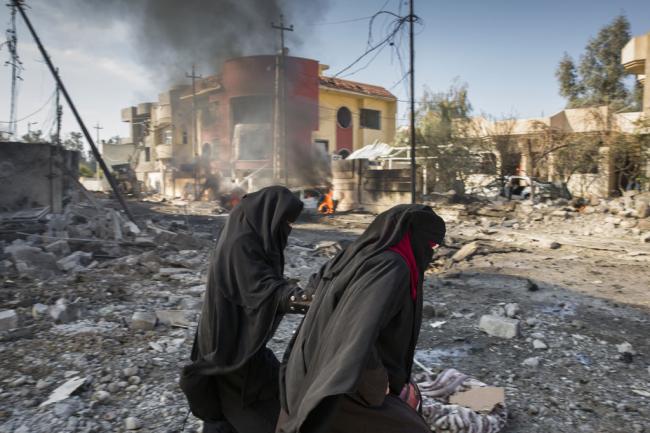
Photo: UNHCR/Ivor Prickett
Source: www.justearthnews.com
Support Our Journalism
We cannot do without you.. your contribution supports unbiased journalism
IBNS is not driven by any ism- not wokeism, not racism, not skewed secularism, not hyper right-wing or left liberal ideals, nor by any hardline religious beliefs or hyper nationalism. We want to serve you good old objective news, as they are. We do not judge or preach. We let people decide for themselves. We only try to present factual and well-sourced news.
Support objective journalism for a small contribution.


