


 Northern Ireland
Centuries-old bonfire tradition sparks outrage after replica mosque set ablaze in Northern Ireland
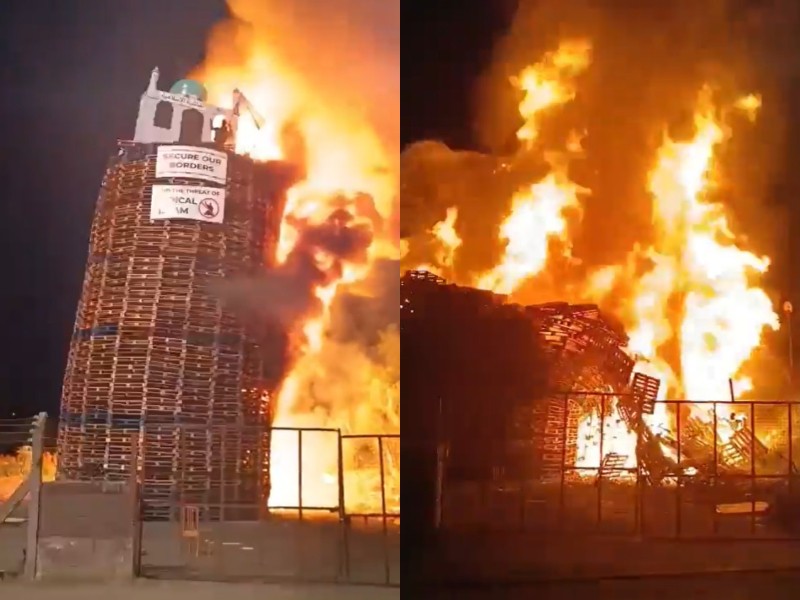
A centuries-old bonfire tradition in Northern Ireland has come under renewed scrutiny after a replica mosque was set alight during an annual loyalist celebration in County Tyrone, prompting a police investigation, political condemnation and renewed concerns over rising anti-Muslim sentiment.
The incident took place in the village of Moygashel during the annual Eleventh Night bonfire celebrations, a tradition dating back more than 300 years that commemorates the 1690 Battle of the Boyne, when Protestant King William III defeated the Catholic King James II.
Replica mosque set ablaze
The bonfire featured a replica mosque erected atop a large stack of wooden pallets.
The structure included an effigy holding what appeared to be an ISIS flag, alongside banners reading "Secure our borders" and "End the threat of radical Islam."
The Moygashel Bonfire Association, which organised the display, acknowledged that the installation could "shock, offend or outrage others" but described it as a protest against what it called "uncontrolled illegal mass immigration."
According to the organisers, the display represented "lawful protected expression" and "political protest," adding that their opposition "is not to people, but rather to ideology and Government policy."
WATCH: Giant bonfire with mosque replica goes up in flames in Moygashel, Northern Ireland; police investigating ‘hate-motivated’ offense pic.twitter.com/sfdvdPgerF
— Rapid Report (@RapidReport2025) July 10, 2026
Police launch 'hate crime' probe
The Police Service of Northern Ireland (PSNI) confirmed it is treating the display as a hate-motivated crime.
A 56-year-old man has been charged with incitement to hatred in connection with the incident.
He denied the charges during a hearing at Dungannon Magistrates' Court on Friday and was refused bail.
Chief Superintendent Norman Haslett said police had intended to remove the display before it was burned.
"Had the bonfire not been lit, police would have secured the site and removed the offending material and seized it as evidence," Haslett said in a statement.
"Hate crime has no place in our society and will not be tolerated," he added.
According to reports, the bonfire was ignited earlier than planned as police prepared to intervene.
Tradition faces renewed criticism
Eleventh Night bonfires are traditionally held in predominantly Protestant loyalist communities on the eve of July 12 celebrations marking King William III's victory at the Battle of the Boyne.
For many loyalists, the bonfires represent a longstanding cultural tradition and an expression of British identity.
However, the events have frequently attracted criticism because of the burning of political symbols, including effigies of the Pope, Irish national flags and other imagery associated with Irish nationalism and Catholicism.
This year's display in Moygashel marked a departure from those themes by focusing on anti-immigration and anti-Islam messaging.
Political and religious leaders condemn
The incident prompted widespread condemnation across Northern Ireland.
Northern Ireland Secretary Hilary Benn described the display as a "sickening and cowardly act of intimidation."
The Church of Ireland and Catholic archbishops also issued a rare joint statement, calling the display "grossly offensive."
Rights groups cite rising anti-Muslim hate
The bonfire came weeks after anti-immigration unrest in Belfast, where clashes between protesters and police resulted in attacks on homes and vehicles, prompting authorities to deploy water cannons.
According to Amnesty International, race-related hate crime in Northern Ireland has reached its highest level since official records began in 2004.
The organisation described the Moygashel display as "a blatant attempt to stir up anti-Muslim hatred and intimidate local families," adding that allowing similar displays to proceed risked normalising racism.
The Muslim Council of Britain (MCB) also highlighted a rise in anti-Muslim incidents across the United Kingdom, stating that an average of four to five incidents were reported each week during June, with more than 40 percent involving arson or firebomb attacks.
Muslim community voices concern
Naomi Green, Assistant Secretary General of the Muslim Council of Britain and a resident of Northern Ireland, said the issue extended beyond cultural celebrations.
"People are welcome to celebrate their culture in whatever way they want," she said.
She added that the concern lay in growing "expressions of hate" and "incitement against certain groups."
Referring to a similar display in Moygashel last year, when an effigy of migrants in a boat was burned, Green said, "I felt physically sick."
She argued that the absence of action following the 2025 incident had contributed to the recurrence this year.
Green also expressed concern about political rhetoric surrounding migrants and Muslims.
"We have politicians come on the radio, talk about alien cultures, talk about barbaric groups of people, as if the Muslims in Northern Ireland are all beheading people, introducing Sharia law, marrying children. That's not who we are."
She further noted that recent public discourse had increasingly conflated Muslims with illegal migration.
"A lot of the rhetoric around that was about Muslims, and this conflation of Muslims as migrants, as illegals. You know, it's all kind of collapsed into one category, even though Muslims are part of the society here."
Support Our Journalism
We cannot do without you.. your contribution supports unbiased journalism
IBNS is not driven by any ism- not wokeism, not racism, not skewed secularism, not hyper right-wing or left liberal ideals, nor by any hardline religious beliefs or hyper nationalism. We want to serve you good old objective news, as they are. We do not judge or preach. We let people decide for themselves. We only try to present factual and well-sourced news.
Support objective journalism for a small contribution.


