


Around 12 million children may never see a classroom, UN data reveals
New York: New data published by the United Nations cultural agency on Friday, reveals that without taking urgent measures, around 12 million young children will never set foot inside a school, with girls facing “the greatest barriers”.
“According to our projections, nine million girls of primary school age will never start school or set foot in a classroom, compared to about three million boys”, said Audrey Azoulay, Director-General of the UN Educational, Scientific and Cultural Organization (UNESCO).
According to updated information on the world’s out-of-school children from the UNESCO Institute for Statistics (UIS), little or no progress has been seen in more than a decade.
“Four of those nine million girls live in sub-Saharan Africa, where the situation gives cause for even greater concern”, Ms. Azoulay continued. “We must therefore continue to centre our actions on girls’ and women’s education, as an utmost priority.”
A grim picture
Last year, roughly 258 million children, adolescents and youth between the ages of six and 17 were out of school.
This new data paints a clear picture of the difficulties ahead in achieving inclusive quality education for all, one of the Sustainable Development Goals (SDGs) set by the international community for 2030.
It also confirms recent UNESCO projections showing that at the present rate, by 2030, one-in-six children will not be attending primary and secondary school at all, and only six in every ten young people will complete secondary education.
The update also highlights the gap between the world’s richest and poorest countries. According to UIS figures, 19 per cent of six-to-11-year olds in low-income countries are out of school, compared to just two per cent in high-income States.
And the gap grows wider still for older children and youth, where some 61 per cent of 15- to 17-year-olds are out of school in low-income countries, compared to eight per cent in their high-income counterparts.
“We have just 11 years to make good on the promise that every child will be in school and learning”, UIS Director Silvia Montoya asserted. “Yet the new data shows us an unchanging and persistent picture of poor access and quality, year after year”.
But Ms. Montoya also flagged that “these challenges are not inevitable”.
“They can be overcome by a combination of intensive action and greater funding”, she maintained. “We need real commitment from every single government, backed by resources, to get the job done.”
The new insight by UIS, the custodian of SDG 4 data, was released a week before the General Assembly meets in New York to examine progress towards the Global Goals and discuss the funding needed to achieve them.
It also demonstrates the pressing need for renewed efforts and reliable data to monitor progress on education access, completion and quality to meet the goal of quality education for all.
Photo caption and credit:
UNICEF/Frank Dejongh
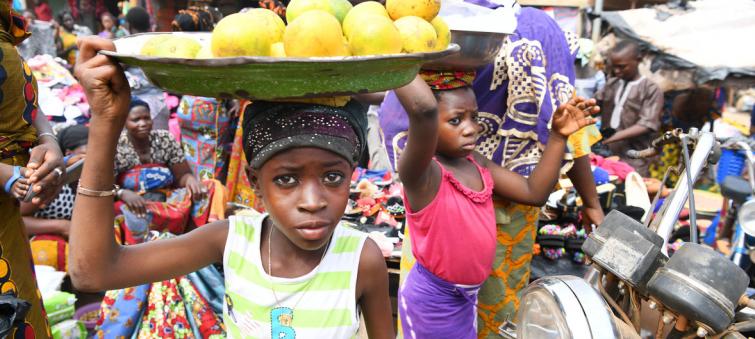
Children working at the market in the town of Korhogo, in the North West of Côte d’Ivoire. (2017)
Support Our Journalism
We cannot do without you.. your contribution supports unbiased journalism
IBNS is not driven by any ism- not wokeism, not racism, not skewed secularism, not hyper right-wing or left liberal ideals, nor by any hardline religious beliefs or hyper nationalism. We want to serve you good old objective news, as they are. We do not judge or preach. We let people decide for themselves. We only try to present factual and well-sourced news.
Support objective journalism for a small contribution.


