


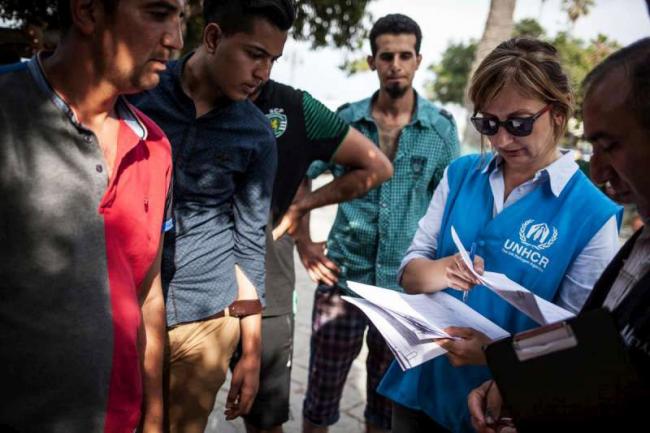
Greece must take robust action to address refugee situation: UN agency
After announcing plans for Vincent Cochetel, Europe Bureau Director of the UN Office for the High Commissioner for Refugees (UNHCR) to visit the country next week, the agency’s spokesperson, William Spindler told reporters in Geneva that in spite of its difficulties, Greece “needs to assume full responsibility for the refugee population, of whom only five per cent have stayed in the country.”
The majority of refugees moved across the Balkans to Germany and Nordic countries.
As the country experiences “real hardship and the situation continues to deteriorate” – with local volunteers and tourists providing more assistance to refugees than the Greek authorities – UNHCR has been assisting on the ground, including by providing water, hygiene kits and interpreters.
The UN agency said that Europe ought to take more robust action to help Greece deal with the situation.
When asked how much of the lack of attention is due to the austerity package, Spindler replied, “Clearly the economic crisis had indeed had its effect, but it is not a new problem as conditions in Greece have been substandard for years. Greece, as a part of the European Union, ought to be helped by the region as a whole.”
He went on to note that some 60 per cent of those arriving in Greece are Syrians coming from Turkey. UNHCR has received only 12 per cent of its funding appeal for operations in Turkey, which was hosting two million Syrian refugees.
“Europe also needs to do more to support Turkey, Lebanon and Jordan, which together hosted more than four million Syrian refugees,” he added.
Spindler explained that most people were coming from the Turkish coast to about 10 Greek islands. While the majority were Syrians, there were also Afghans, Iraqis and sub-Saharan Africans.
“Local authorities said they lacked necessary resources, but it was also an issue of political will. Greece should assume its responsibility,” he stressed.
Responding to another question, Spindler said the registration process of new arrivals needed to be sped up.
He said, “Reception conditions, which are appalling, have to be urgently improved. Much more needs to be done.”
Currently, local volunteers provided water and food upon initial reception.
On another question, the spokesperson said that a recent decision by the Justice and Home Affairs Council to take in 22,000 Syrian refugees for resettlement and relocating another 32,000 asylum seekers already in Europe was a move in the right direction, but more had to be done, and fast.
He flagged, “There are many simultaneous crises around the world, which is why it is increasingly difficult to raise funds for all of them.”
In answer to where the refugees would go after leaving the country, Spindler said that the number of people seeking asylum in Greece had gone up, but it was still a small number percentage-wise.
He said, “Most others would transit through Macedonia, Serbia and Hungary on their way to Germany, the Netherlands and northern European bcountries. Sometimes the refugees face physical obstacles, and there have been cases of violence against them by border guards."
He added, "A large percentage of those arriving in Greece and moving onwards have relatives in Germany and other countries.”
Spindler concluded: “Legal avenues for refugees to come to Europe ought to be looked into, and European countries should facilitate family reunification.”
Photo: UNHCR/S. Baltagiannis
Support Our Journalism
We cannot do without you.. your contribution supports unbiased journalism
IBNS is not driven by any ism- not wokeism, not racism, not skewed secularism, not hyper right-wing or left liberal ideals, nor by any hardline religious beliefs or hyper nationalism. We want to serve you good old objective news, as they are. We do not judge or preach. We let people decide for themselves. We only try to present factual and well-sourced news.
Support objective journalism for a small contribution.


