


Heavy fighting in eastern Ukraine extracting heavy civilian toll, UN Security Council hears
“Since 7 January this year, and in particular over the last few days, we have seen a dangerous intensification of the conflict,” Jeffrey Feltman, the UN Under-Secretary-General for Political Affairs told Council members on Thursday.
“The entire length of the ‘Contact Line’ has seen a serious escalation of hostilities, and there is still a risk of further deterioration of the situation,” added Feltman.
According to reports, there were more than 10,000 explosions in the Donetsk region over 24 hours, and heavy fighting has been reported near Mariupol, Popasna and the Svitlodarsk/Debaltseve areas, both in Government-controlled and non-government controlled areas, along with use of heavy weapons such as multiple-launch-rocket systems which are prohibited by the Minsk Agreements.
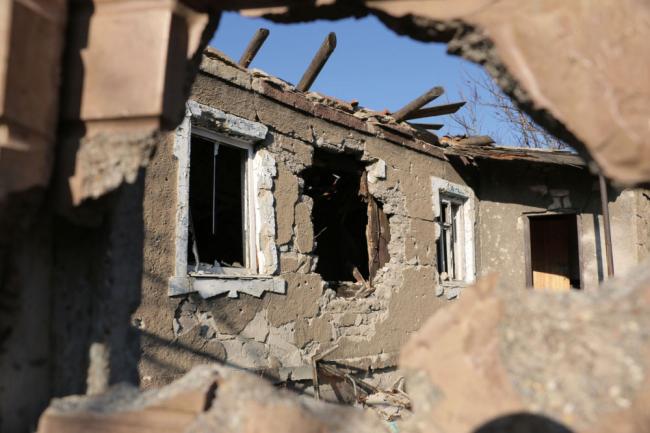
Furthermore, the UN Human Rights Monitoring Mission has recorded damage to civilian houses and a school in populated areas of Avdiivka, raising serious concerns about possible violations of international humanitarian law by all sides.
Since the start of the conflict, almost 10,000 people have been killed (Ukrainian armed forces, civilians and members of armed groups), and over 23,000. Over 2,000 of those killed were civilians.
Feltman also spoke of the statement agreed yesterday at the meeting of the Trilateral Contact Group in Minsk which laid down urgent measures that both sides should take not only in the Avdiivka-Yasynuvata-Donetsk airport area, but along the entire contact line in order to prevent further ceasefire violations that could in turn spiral out of control.
“This is a positive development, but the test will be in the implementation of the measures,” he said noting that the pattern of successive ceasefire agreements broken by fresh violence left civilians caught in the crossfire and trapped in suffering.
“With every new day of fighting, the conflict becomes more entrenched and difficult to resolve. There is no military solution to this conflict,” he said.
Also briefing the Security Council on Thursday, UN Emergency Relief Coordinator Stephen O’Brien highlighted the impact of the conflict to civilians underlined the need for a political solution to the crisis.
“Civilians living on both sides of the frontline […] are not only traumatized, living a precarious and dangerous existence, but damage to critical services is making survival an issue,” said O’Brien, adding that damage to critical infrastructure such heating in places such as Avdiivka and the freezing temperatures could trigger large-scale displacement.
The latest escalation of violence is exasperating the ongoing needs of an estimated 3.8 million civilians who require various degrees of humanitarian assistance. More than 60 per cent of those (about 2.3 million people) reside in non-Government controlled areas, and over 70 per cent are elderly, children and women.
Further, noting that the while some humanitarian response efforts continue, undue bureaucratic restrictions which have been imposed since July 2015 by the de facto authorities in Donetsk and Luhansk regions have severely affecting humanitarian access.
He also reported that, Government-imposed bureaucratic impediments, particularly in relation to the ban on commercial trade and importation of food and medicines across the ‘contact line,’ remained a serious constraint to alleviating the humanitarian crisis and that suspension of social payments by the Government have severely affected hundreds of thousands of displaced people.
In his briefing, O’Brien also alerted the Security Council of the risk of serious environmental impact of the hostilities, he said:
“Damage to the Phenol plant near Novgorodske village means that waste chemicals, including deadly sulfuric acid and formaldehyde, are now at critical levels [and] leakage into the surrounding land and the Seversky Donets River would have disastrous humanitarian consequences in a highly industrialized part of Europe.”
Photo: Daniel Gerstle/IRIN
Source: www.justearthnews.com
Support Our Journalism
We cannot do without you.. your contribution supports unbiased journalism
IBNS is not driven by any ism- not wokeism, not racism, not skewed secularism, not hyper right-wing or left liberal ideals, nor by any hardline religious beliefs or hyper nationalism. We want to serve you good old objective news, as they are. We do not judge or preach. We let people decide for themselves. We only try to present factual and well-sourced news.
Support objective journalism for a small contribution.


