


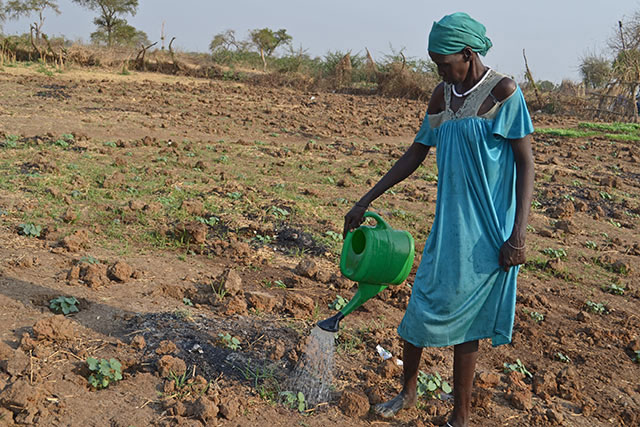
Looking beyond ‘quick-fix’ solutions, UN agencies help South Sudan refugees become self-sufficient
This year, the Office of the UN High Commissioner for Refugees (UNHCR) and the Food and Agriculture Organization (FAO) have jointly contributed 186 tons of crop seeds, assorted vegetable seeds, hand tools and fishing kits for refugees and local communities in Unity, Upper Nile, Jonglei, Central Equatoria and Western Equatoria.
“We are pleased to announce that these interventions are working well, but we are also looking beyond quick-fix solutions that help refugees become more self-reliant and less dependent on humanitarian assistance in the long run,” said UNHCR Representative Ahmed Warsame. “This is the essence of the UNHCR-FAO partnership.”
“People here lack the resources to buy the things they need to start planting and need support to be able to produce their own food,” said FAO Representative Serge Tissot. “These distributions have been very timely since the planting season has just started.”
Assessments have shown that the food and nutrition security situation is worrying in many parts of the country, including in Upper Nile – a region hosting four refugee camps and South Sudan’s largest refugee population of 134,000 Sudanese refugees.
A nutrition survey, conducted in late 2015, found that Upper Nile’s Maban refugee camps registered higher levels of malnutrition compared to 2014. This was particularly the case in Doro camp, where the rates of Global Acute Malnutrition (GAM) and Severe Acute Malnutrition (SAM) were respectively 15.5 per cent and 2.6 per cent – above UNHCR standards of 10 per cent and 2 per cent.
“Without seed distributions we cannot survive. Not all of us are able to keep seeds for next year, some people do, but because of lack of food, sometimes we are forced to eat the seeds kept for planting,” said a Sudanese refugee from Blue Nile state. “We hope for peace so that we can return home, where we can be free.” she added.
Photo: FAO
Source: www.justearthnews.com
Support Our Journalism
We cannot do without you.. your contribution supports unbiased journalism
IBNS is not driven by any ism- not wokeism, not racism, not skewed secularism, not hyper right-wing or left liberal ideals, nor by any hardline religious beliefs or hyper nationalism. We want to serve you good old objective news, as they are. We do not judge or preach. We let people decide for themselves. We only try to present factual and well-sourced news.
Support objective journalism for a small contribution.


