


Prolonged political crisis could erode Guinea Bissau’s development gains, UN envoy warns
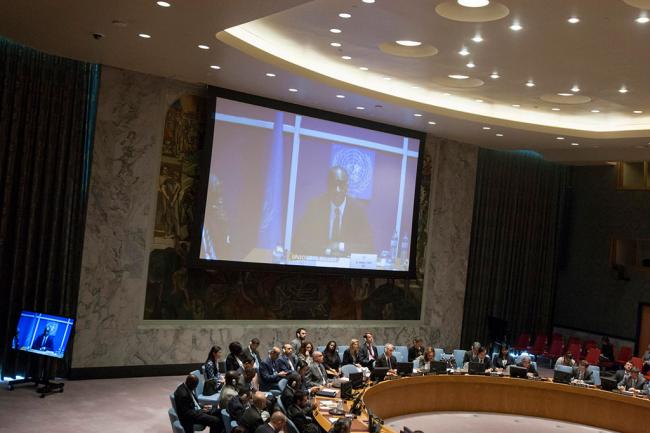
“The current situation calls for innovative strategies to deliver services and support the resilient population of Guinea-Bissau,” Modibo Touré, the Secretary-General’s Special Representative and head of the UN Integrated Peacebuilding Office in Guinea-Bissau (UNIOGBIS) said on Tuesday in his first briefing to the 15-nation Council.
On 26 May 2016, President Josd Mfirio Vaz appointed Baciro Djfi as Prime Minister through a presidential decree. Djfi’s Cabinet was sworn in on 2 June. However, the dismissed Cabinet led by Carlos Correia refused to leave the Government Palace.
In an attempt to defuse tensions, the Special Representative said that he had met with these key figures, appealing for restraint, political dialogue and respect for the rule of law.
Following intense overnight negotiations involving, representatives of the civil society, religious leaders, the Economic Community of West African States (ECOWAS) mission in Guinea-Bissau (ECOMIB) and UNIOGBIS, the remaining members of the dismissed Cabinet and their supporters peacefully vacated the Government Palace, ending a 14-day stalemate on 9 June.
“The peaceful resolution of this standoff may have helped avert a potentially serious crisis, but further challenges loom ahead,” Touré said.
The ruling PAIGC party has initiated legal proceedings challenging the President’s recent appointments. Furthermore, the status of the 15 Members of Parliament (MPs) expelled by the PAIGC in January, as well as the ongoing impasse at the People’s National Assembly, add to the legal confusion and institutional uncertainty facing the country.
“Regardless of the judicial outcomes, a sustainable solution to the ongoing political crisis can only be found through genuine political dialogue,” Touré said. “Yet, one of the primary fora for such dialogue – the People’s National Assembly – suspended its current session on 18 May as a result of disputes over the agenda and the status of the 15 MPs. Earlier on Tuesday, that parliamentary session was closed; the next one is expected to open later this month.”
Welcoming the decision of ECOWAS
He welcomed the decision of ECOWAS Heads of State on 4 June to extend the mandate of ECOMIB [ECOWAS Mission in Guinea Bissau] for another year, with the understanding that the international community would provide funding.
While the primary focus is on finding a political and sustainable solution, it is also important to provide the required support to the people of Guinea-Bissau, whose lives and livelihoods have been adversely impacted by the country’s recurrent instability, Touré said.
Strikes in the health and education sectors in March and April have seriously affected the school year and deprived citizens of key preventative and medical services, including maternal and child health.
“The longer the crisis continues, the more likely will we see a setback to the gains of the post-electoral period, including positive economic growth, increase in revenues and the commitment to key reforms in defence and security, justice and public services,” he said.
In a country where the official development assistance (ODA) amounts to about 15 per cent of gross domestic product (GDP) and almost 80 per cent of the budget, the current suspension of disbursements and direct budget support from the International Monetary Fund (IMF), the World Bank, the European Union and the African Development Bank creates a financial pressure that could negatively affect the running of the State, including the payment of salaries, he warned.
“The attention given by the Security Council to the situation in Guinea Bissau, and its support to the search for a sustainable solution to the political and institutional challenges in the country are of utmost importance,” he concluded.
UN Photo/Loey Felipe
Source: www.justearthnews.com
Support Our Journalism
We cannot do without you.. your contribution supports unbiased journalism
IBNS is not driven by any ism- not wokeism, not racism, not skewed secularism, not hyper right-wing or left liberal ideals, nor by any hardline religious beliefs or hyper nationalism. We want to serve you good old objective news, as they are. We do not judge or preach. We let people decide for themselves. We only try to present factual and well-sourced news.
Support objective journalism for a small contribution.


