


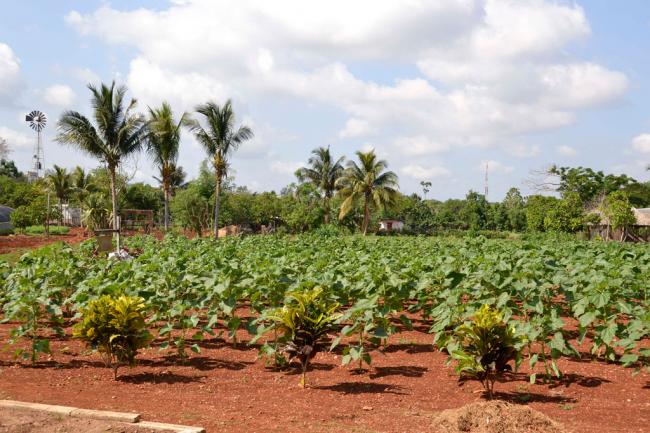
UN-backed disaster risk reduction guidelines to help tackle hunger in Latin America
“This transition cannot be achieved without the development of sectoral measures for disaster risk management involving technologies, productive practices and sustainable use of natural resources, as well as considerable changes in terms of governance, legislation, policies and public and private investment,” said Jorge Meza, chief forestry officer of the UN Food and Agriculture Organization (FAO).
Entitled Guidelines and Recommendations for the Implementation of the Sendai Framework for Disaster Risk Reduction in the Agricultural and Food and Nutrition Security Sector: Latin America and the Caribbean, the document is a guide for such a transition, which was envisioned by the 15-year Framework – the most risk-focused international plan ever on curbing the impact of natural and human-induced hazards – adopted in March 2015.
The guidelines, crafted by the UN Office for Disaster Risk Reduction (UNISDR), FAO and the Organization of American States, also aim to support the implementation of a roadmap set down by the 33-nation Community of Latin American and Caribbean States, the ‘CELAC Plan for Food Security, Nutrition and Hunger Eradication 2025.’
More than 34 million people in Latin America and the Caribbean still suffer from hunger, with the majority of them concentrated in the countryside.
Millions of producers in the region’s poorest rural areas are family subsistence farmers and at very high risk, given that the impact of disasters goes beyond the momentary loss of income or opportunities and directly impacts food security and survival.
Therefore, the effect of disasters on the sector and the consequences of climate change not only endanger development gains in rural territories of Latin America and the Caribbean, but also the very food and nutritional security of its entire population. They also undermine the ability of the region to cope in a context where global population growth is driving an expected 60-per cent increase in food demand by 2050.
Momentum on the issue has also been built thanks to last year’s 34th FAO Regional Conference for Latin America and the Caribbean, hosted by Mexico, which focused attention on the need to boost disaster risk reduction efforts in the sector. This May, Mexico is also set to host the 2017 Global Platform for Disaster Risk Reduction.
Photo: FAO photo
Source: www.justearthnews.com
Support Our Journalism
We cannot do without you.. your contribution supports unbiased journalism
IBNS is not driven by any ism- not wokeism, not racism, not skewed secularism, not hyper right-wing or left liberal ideals, nor by any hardline religious beliefs or hyper nationalism. We want to serve you good old objective news, as they are. We do not judge or preach. We let people decide for themselves. We only try to present factual and well-sourced news.
Support objective journalism for a small contribution.


