


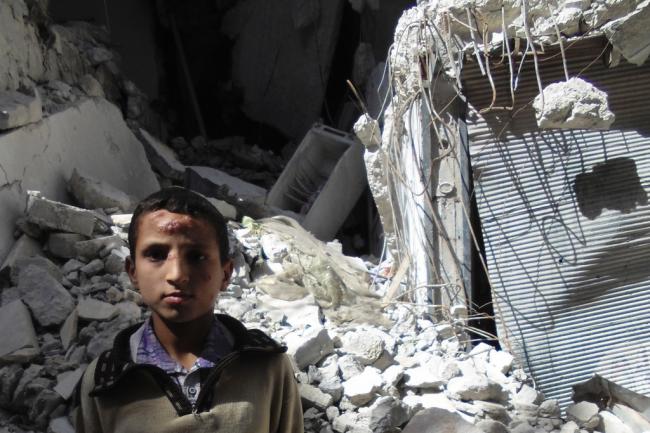
UN envoy says it is now time to have 'a real discussion' to end Syrian conflict
“I think Aylan has been telling us this – there is no time anymore for long-term conferences and discussions. Now is the time to really look in the eyes of those who are telling us “we have no more hope, we have no more patience,” said Staffan de Mistura, referring to the three-year-old Aylan Kurdi, whose body washed up on shore last week.
“There is no more time for long political processes, there is a need to create concrete hope for the people in Syria,” Staffan told reporters in Brussels, Belgium, where he held discussions with senior European Union officials.
The UN envoy stressed that now is the time to have “a real discussion.”
“If Saudi Arabia and Iran would finally start talking to each other and talking about something that could be a Helsinki type of arrangement... the conflict will last one more month – not one year, not 10 years,” he said, “because oxygen will disappear from the conflict.”
Staffan pointed out that Saudi Arabia and Iran have “substantial influence” in Lebanon, Yemen, Iraq and Syria, and that talks between the two could contribute to ending the conflict provided the two countries “were not alone at the table.”
“I’ve been 43 years with the UN, 19 conflicts, people start talking when there is lack of sponsorship for the actual conflict,” the envoy said. “Oxygen taken away from the fire, the fire goes off.”
He welcomed discussions on Syria between the United States and Russia, “which is a good sign, but they have not yet come up with a concrete outcome on the main issue of what is going to be the future of the governance of Syria.”
Europe, he said, was not involved in the conflict but could contribute by establishing a common understanding on how to receive refugees with dignity and by trying to fill the gap of funding, not least since only 31 per cent of the funds promised to the UN agencies for the more than 4 million refugees in Jordan, Turkey and Lebanon had been delivered.
Meanwhile, the UN refugee agency warned that “as the crisis digs deeper into its fifth year with no sign of a political solution in sight, despair is on the rise and hope is in short supply.”
The last few months have been brutal, according to the UN High Commissioner for Refugees (UNHCR).
Fighting has intensified in almost all governorates, with rocket and mortar attacks on Damascus increasing, rising vehicle explosions in major cities and heavy bombardments with ensuing retaliation driving thousands more people from their homes.
Amid the escalating violence, the agency said unemployment is soaring alongside inflation, while the value of the currency plummets – the Syrian pound has lost 90 per cent of its value over the last four years. In most parts of Syria, electricity is available only 2-4 hours a day, if at all, and many regions struggle with water shortages. More than half the population lives in extreme poverty.
For the refugees already in neighbouring countries – the vast majority of whom live outside of formal camps – hope is also dwindling as they sinker deeper into abject poverty.
Against this backdrop, the World Food Programme (WFP) has been forced to cut food assistance to 229,000 refugees in Jordan this month – the latest and largest in a series of reductions in food aid across the region this year due to severe funding shortfalls.
Photo: OCHA/Gemma Connell
Support Our Journalism
We cannot do without you.. your contribution supports unbiased journalism
IBNS is not driven by any ism- not wokeism, not racism, not skewed secularism, not hyper right-wing or left liberal ideals, nor by any hardline religious beliefs or hyper nationalism. We want to serve you good old objective news, as they are. We do not judge or preach. We let people decide for themselves. We only try to present factual and well-sourced news.
Support objective journalism for a small contribution.


