


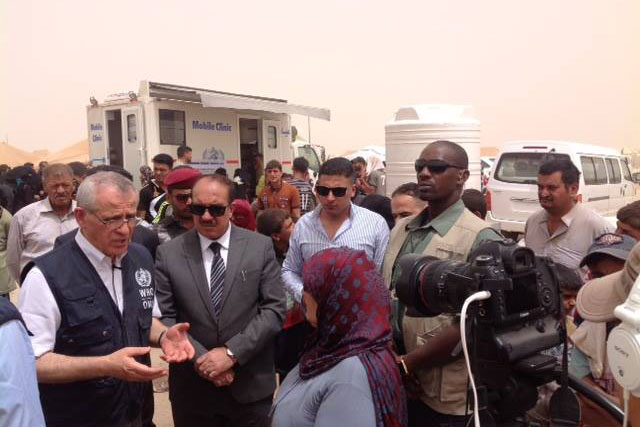
UN health agency expresses concern over disease outbreaks in besieged city of Fallujah
“The health situation inside and around Fallujah is deeply worrying,” said Ala Alwan, Regional Director for the Eastern Mediterranean of the World Health Organization (WHO) on his visit to Baghdad. “We are concerned about the low immunity status of children as no immunization services have been possible for the past two years,” he explained.
Additionally, it is estimated that hundreds of pregnant women are trapped in Fallujah and are in urgent need of reproductive health services, Dr. Alwan noted.
To detect and respond to any potential disease outbreaks, WHO is operating 13 early warning sites in Al-Anbar governorate and has provided health care providers with training on disease reporting and tablets to document and report possible outbreaks.
Given the projected increase in humanitarian health needs in and around Fallujah, the challenge is immense, said Dr. Alwan.
He met with high-level Iraqi officials to discuss the health needs of displaced persons, as well as those who remain trapped inside Fallujah, 60 km west of Baghdad.
“The situation is extremely difficult and complex. Additional resources are required to provide urgent health assistance to thousands of families. WHO is disappointed by the inadequate levels of funding for the health sector, which is a major impediment to the response,” Dr. Alwan concluded.
WHO has established a new primary health care centre with a local partner in Amiriyat Al Fallujah to serve the internally displaced population, including the nearly 3,250 families, or 19 500 persons, living in five camps for internally displaced persons (IDPs) and five informal settlements around the Bzibiz area.
WHO has also supported the Ministry of Health and partners in distributing 15 tonnes of medicines, medical supplies and emergency kits to the civilians moving out of Fallujah to IDP camps in Ramadi, Khalidiya, and Amiriyat Al Fallujah areas. These shipments include a wide range of life-saving medicines for acute and chronic diseases, trauma kits and surgical supplies.
WHO also continues to operate eight mobile medical clinics to provide urgently needed health services in Al-Anbar governorate; three of which were deployed to provide these services in Al Fallujah IDP camps.
Photo: WHO
Source: www.justearthnews.com
Support Our Journalism
We cannot do without you.. your contribution supports unbiased journalism
IBNS is not driven by any ism- not wokeism, not racism, not skewed secularism, not hyper right-wing or left liberal ideals, nor by any hardline religious beliefs or hyper nationalism. We want to serve you good old objective news, as they are. We do not judge or preach. We let people decide for themselves. We only try to present factual and well-sourced news.
Support objective journalism for a small contribution.


