UN Member States set to adopt ‘historic’ treaty prohibiting nuclear weapons
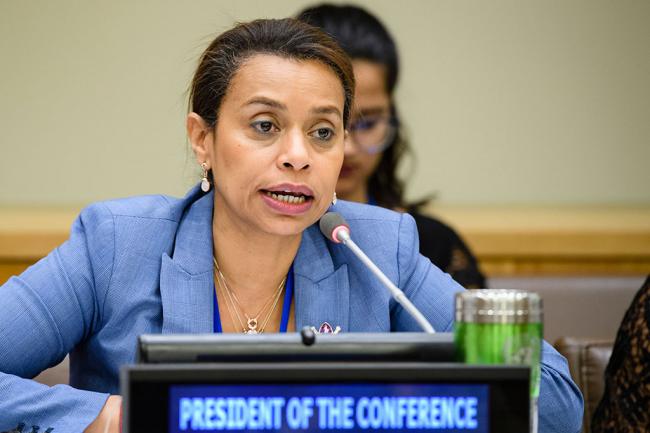
“After our final review of the text yesterday, I am convinced that we have achieved a general consensus on a robust and comprehensive prohibition,” said Ambassador Elayne Whyte Gómez of Costa Rica, who serves as the President of the conference to negotiate a legally-binding instrument to prohibit nuclear weapons.
“This will be a historic moment and it is the first multilateral nuclear disarmament treaty to be concluded in more than 20 years,” she told a news conference at UN Headquarters.
According to the draft text, the treaty covers the full range of nuclear-weapons-related activities, prohibiting undertaking by any State party to develop, test, produce, manufacture, acquire, possess or stockpile nuclear weapons or other nuclear explosive devices.
The prohibitions also include any undertaking to use or threaten to use nuclear weapons or other nuclear explosive devices.
The treaty will be open for signature to all States at UN Headquarters in New York on 19 September 2017, and enter into force 90 days after the 50th instrument of ratification, acceptance, approval or accession has been deposited.
To date, however, a number of countries have stayed out of the negotiations, including the United States, Russia and other nuclear-weapon States, as well as many of their allies. The Democratic People’s Republic of Korea (DPRK) has not joined the talks either.
In a recent interview, the newly appointed High Representative for Disarmament Affairs, Izumi Nakamitsu, told UN News that “nuclear-weapon States and some of their allies are not able to join the negotiations at the moment, but hopefully a treaty will be something they will be able to join eventually.”
She said that “the door must be open to all States, and this inclusiveness will have to be built into the treaty.”
The draft treaty does include various pathways for nuclear-armed States to join. For instance, a State must first eliminate its nuclear weapons programme prior to joining. That State would then need to cooperate with the UN International Atomic Energy Agency (IAEA) in verifying the correctness and completeness of its nuclear inventory, thus following the same path as South Africa in the 1990s.
“Since this is a negotiation, no delegation can leave having gained everything they asked for from their national perspective,” noted Gómez, while adding that she was confident that “the final draft has captured the aspirations of the overwhelming majority of those participating in the conference, including civil society, whose enthusiasm, knowledge and collective experience have been a key driver of this process.”
In response to questions, Gómez stressed the importance of putting an international legal norm in place as a first step towards achieving a nuclear-weapons-free world, explaining that when conditions later become ripe for those nuclear-armed States to join, an architecture by which to do so exists.
All humanity expects that nuclear-armed States join the treaty “sooner than later,” but “I have no dates,” she said.
Asked about the impact on the negotiations of the current tensions over the DPRK’s nuclear programme and ballistic missiles activities, she said that having a norm in place does influence the behaviors of a State. It also plays a fundamental role in shaping a new security paradigm for the 21st century, she added.
“The treaty, no doubt, will compliment and strengthen the global architecture on nuclear disarmament and the non-proliferation regime. This is a historic event for humanity.”
Photo: UN Photo/ Manuel Elias
Source: www.justearthnews.com
Support Our Journalism
We cannot do without you.. your contribution supports unbiased journalism
IBNS is not driven by any ism- not wokeism, not racism, not skewed secularism, not hyper right-wing or left liberal ideals, nor by any hardline religious beliefs or hyper nationalism. We want to serve you good old objective news, as they are. We do not judge or preach. We let people decide for themselves. We only try to present factual and well-sourced news.
Support objective journalism for a small contribution.