


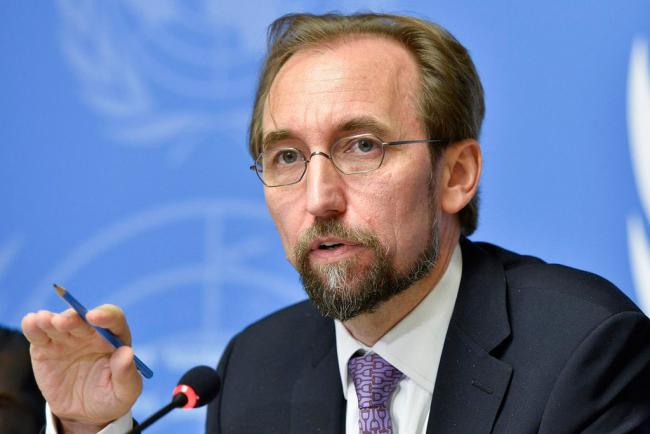
UN rights chief concerned by 'broad scope' of China's new security law
“This law raises many concerns due to its extraordinarily broad scope coupled with the vagueness of its terminology and definitions,” said UN High Commissioner for Human Rights Zeid Ra'ad Al Hussein in a press statement.
“As a result, it leaves the door wide open to further restrictions of the rights and freedoms of Chinese citizens, and to even tighter control of civil society by the Chinese authorities than there is already.”
The new legislation covers a large spectrum of issues and defines the meaning of national security extremely broadly, stressed UNHCR: it is described as the condition in which the country's government, sovereignty, unification, territorial integrity, well-being of its people, sustainable development of its economy and society and other major interests are “relatively safe and not subject to internal and external threats.”
“The law should clearly and narrowly define what constitutes a threat to national security, and identify proper mechanisms to address such threats in a proportionate manner,” Zeid said, adding that, by doing so, individuals will be enabled to foresee the consequences of their conduct, as well as to safeguard against arbitrary or discriminatory enforcement by authorities.
For instance, articles in the law envisage the mobilisation of citizens to guard against and report on security threats to the authorities, but the type of conduct that is considered to be a danger to national security is not defined, conferring broad discretion and leaving potential for abuse.
The law also states that individuals and organizations must not act to endanger national security neither provide any kind of support or assistance to individuals or organizations endangering national security, without specifying the precise scope of any of these terms.
Welcoming the fact that the new security law makes specific references to the Constitution, to the rule of law and to the respect and protection of human rights, Zeid said he is concerned about the lack of independent oversight.
“States have an obligation to protect persons under their jurisdiction – but they also have an obligation to guarantee respect for their human rights. Restrictions on the rights to freedom of expression and peaceful assembly need to serve a legitimate aim [and] be necessary and proportionate, and there should be independent oversight of the Executive,” the High Commissioner said.
Zeid also noted that China's National People's Congress will in the near future also consider laws on the regulation of foreign NGOs operating in China and on counter-terrorism.
“I regret that more and more Governments around the world are using national security measures to restrict the rights to freedom of expression, association and peaceful assembly, and also as a tool to target human rights defenders and silence critics,” he said. “Security and human rights do not contradict each other. On the contrary they are complementary and mutually reinforcing. Respect for human rights and public participation are key to ensuring rule of law and national security.”
UN Photo/Jean-Marc Ferré
Support Our Journalism
We cannot do without you.. your contribution supports unbiased journalism
IBNS is not driven by any ism- not wokeism, not racism, not skewed secularism, not hyper right-wing or left liberal ideals, nor by any hardline religious beliefs or hyper nationalism. We want to serve you good old objective news, as they are. We do not judge or preach. We let people decide for themselves. We only try to present factual and well-sourced news.
Support objective journalism for a small contribution.


