Bill banning Triple Talaq is aimed at securing justice to women: Vice President Naidu
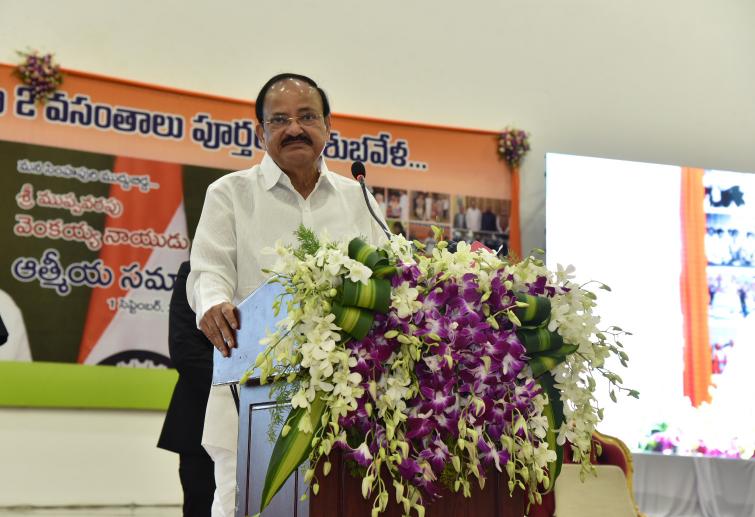
New Delhi, Sept 1 (IBNS): Vice President of India M. Venkaiah Naidu has hailed the Muslim Women (Protection of Rights on Marriage) Bill, 2019, passed in the Rajya Sabha the other day, and said that it was aimed at securing gender rights and justice to women.
The Vice President said that the passing of the Bill was a great moment in India’s legislative history.
“It is a major social reform bill that will go a long way in ensuring justice to Muslim women”, he added.
Speaking at the Diamond Jubilee Celebrations of Janki Devi Memorial College in New Delhi, Naidu said this was long overdue for a country that has taken great pride in its deep-rooted principles of democracy, secularism and equality.
The Vice President stressed that investing in women’s capabilities and empowering them were important for propelling economic growth and overall development.
He observed that women’s education has been found to have a more significant effect on lowering poverty and promotion of sustainable development.
Pointing out that women’s literacy was more than just about economic opportunities, the Vice President said that increasing knowledge and awareness among women would have a huge, positive impact on the society.
Naidu said that a country like India could not neglect the importance of education and the empowerment of the women, especially when it was aspiring to be a 5 trillion-dollar economy and striving to acquire a position of leadership in the world.
Quoting the International Monetary Fund (IMF) Report, Naidu said that raising women's labour force participation to that of men could boost GDP by as much as 27 percent in India.
“If 50% of skilled women could join the workforce, India can scale its growth by 1.5 percentage points to 9% a year. India needs its women to contribute to the workforce,” he added.
Opining that empowerment of women would enable them to respond to the challenges, improve their status within the family and participate in the decision making, the Vice President said that a happy family and a healthy and robust society could not be sustained without the active participation of women.
Observing that education was the foundation, on which the progress of a nation depends, the Vice President stressed the need to provide good quality and affordable education to our young people.
He said education would help India convert its demographic dividend to achieve all-round and inclusive development of the nation.
Naidu called upon the universities and schools to strive to become the centres of excellence where knowledge was imparted, skills were honed, character was built, curiosity was inspired and morals were fortified.
To achieve this, the Vice President said that there was an urgent need to reorient the education system.
He said that India ‘simply cannot harbour an obsolete an educational system that promotes mediocrity, rote learning, stifles creativity and pulls us backwards instead of propelling us forward into the future.’
Naidu wanted educational institutions to shun the status quo and embrace change in accordance with the changing times and constantly and objectively evaluate the curricula, teaching methodologies and upgrade research facilities.
Opining that education does not, by itself could make a person employable, the Vice President asserted that educational institutions must impart essential skills to students, including crucial life skills required for the knowledge-driven, interconnected world of the 21st century.
Naidu appreciated the institute’s initiatives such as the rainwater harvesting system and Equal Opportunities Cell to support economically challenged students.
Support Our Journalism
We cannot do without you.. your contribution supports unbiased journalism
IBNS is not driven by any ism- not wokeism, not racism, not skewed secularism, not hyper right-wing or left liberal ideals, nor by any hardline religious beliefs or hyper nationalism. We want to serve you good old objective news, as they are. We do not judge or preach. We let people decide for themselves. We only try to present factual and well-sourced news.
Support objective journalism for a small contribution.