 SIR Row
Contempt case against CEC Gyanesh Kumar? Supreme Court advocate seeks AG's consent
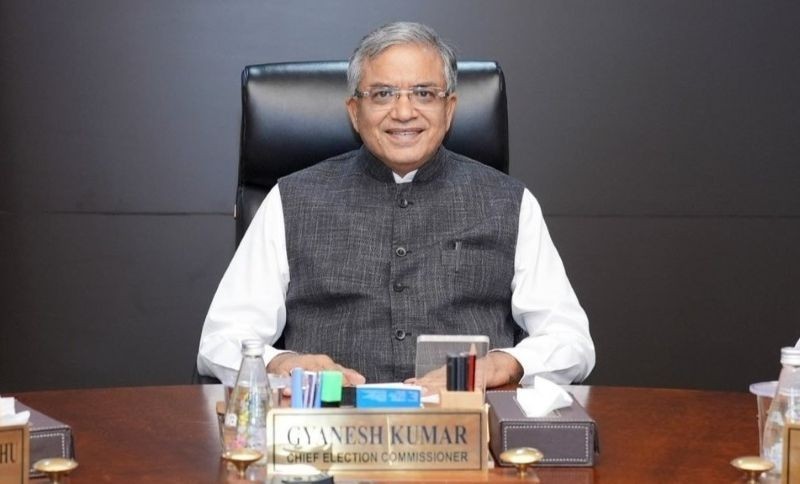
New Delhi/IBNS: A Supreme Court advocate has sought the consent of Attorney General for India R. Venkataramani to initiate criminal contempt proceedings against Chief Election Commissioner (CEC) Gyanesh Kumar, following a recent investigative report concerning the functioning of the Election Commission of India (ECI) and the controversial Special Intensive Revision (SIR).
According to LiveLaw, advocate Brajesh Singh made the request in a letter to the Attorney General on September 24, invoking Section 15(1)(b) read with Section 2(c) of the Contempt of Courts Act, 1971, and Rule 3 of the Rules to Regulate Proceedings for Contempt of the Supreme Court, 1975.
Advocate alleges violation of Supreme Court judgments
Singh referred to reports that Election Commissioners Sukhbir Singh Sandhu and Vivek Joshi had raised objections to several decisions concerning the poll panel's functioning.
Citing the reported objections, Singh alleged that certain decisions amounted to a departure from the constitutionally mandated functioning of the three-member Election Commission.
He also referred to the Supreme Court's judgment in T.N. Seshan v. Union of India, arguing that the Election Commission is required to function as a multi-member constitutional body and that the CEC is the "first among equals" rather than an absolute authority.
Singh further argued that the CEC is not "mightier than the institution" and that decisions of the multi-member ECI are decisions of the Commission, rather than of its chairperson.
Reference to Anoop Baranwal judgment
The advocate also cited the Supreme Court's 2023 judgment in Anoop Baranwal v. Union of India, which dealt with the institutional independence of the Election Commission and the appointment process for the Chief Election Commissioner and other Election Commissioners.
Singh relied on the judgment while stressing the importance of an independent Election Commission in ensuring free and fair elections.
The request for consent comes after The Indian Express reported that Election Commissioners Sukhbir Singh Sandhu and Vivek Joshi had recorded objections on at least 14 occasions over the preceding 10 months to certain decisions taken by the poll panel.
ECI denies claims of internal rift
The Election Commission has rejected the suggestion of a rift within the poll panel, saying the matters raised by the two Election Commissioners were operational queries, inputs and suggestions made during the drafting process and that decisions were ultimately taken unanimously.
Under Section 15(1)(b) of the Contempt of Courts Act, a criminal contempt motion in the Supreme Court by a person other than the Attorney General requires the Attorney General's written consent. If such consent is granted, contempt proceedings may subsequently be instituted before the Supreme Court.
What The Indian Express report said
The controversy follows a report by The Indian Express that detailed differences within the three-member Election Commission involving CEC Gyanesh Kumar and Election Commissioners Sukhbir Singh Sandhu and Vivek Joshi.
According to the investigation, Sandhu and Joshi formally raised objections at least 14 times over a period of 10 months to decisions and orders concerning electoral rolls and the SIR. They reportedly said some decisions had been taken without their knowledge.
The objections covered changes to Form 6, access to the electoral-roll database, deletion and restoration of voter names, appeals related to electoral rolls and aspects of the ECI's internal decision-making.
The two Election Commissioners also reportedly raised concerns over what they described as the gradual centralisation of the electoral-roll database.
Electoral Registration Officers (EROs) at the constituency level have statutory responsibility for preparing and maintaining electoral rolls.
According to the investigation, Joshi called for an audit to ensure that only authorised statutory officials could alter the voter database, while Sandhu recorded complaints from state-level officials that they did not have "proper and complete access" to the relevant systems.
The report also said the two Commissioners separately wrote to Cabinet Secretary T V Somanathan over changes in the ECI's work allocation that they felt could further concentrate control over the IT systems handling electoral rolls.
Election Commission rejects claims of internal rift
The Election Commission has disputed the interpretation of the report, saying that written objections, suggestions and differing views are part of its internal deliberative process.
EC sources said all decisions, including those concerning the SIR, were taken with the approval of all three Election Commissioners and were unanimous.
Support Our Journalism
We cannot do without you.. your contribution supports unbiased journalism
IBNS is not driven by any ism- not wokeism, not racism, not skewed secularism, not hyper right-wing or left liberal ideals, nor by any hardline religious beliefs or hyper nationalism. We want to serve you good old objective news, as they are. We do not judge or preach. We let people decide for themselves. We only try to present factual and well-sourced news.
Support objective journalism for a small contribution.